“What attracts you?” Laura asked, head cocked like a bird probing.
“The persistence and powerful pull of the idea of God . . .,” I said, for this dear friend was helping me to open a heavy door in my psyche. “I am amazed at the churches, chapels and temples people have built in which they worship God. They are beautiful—and they are seemingly everywhere.”
Visualizing a white stone building on distant green hills in Scotland, stepping into the eye-lifting, jaw-dropping space of Chartres Cathedral, and standing outside a shuttered beauty of shingle and fieldstone: the Virginia Street Church in St. Paul, designed by Cass Gilbert.
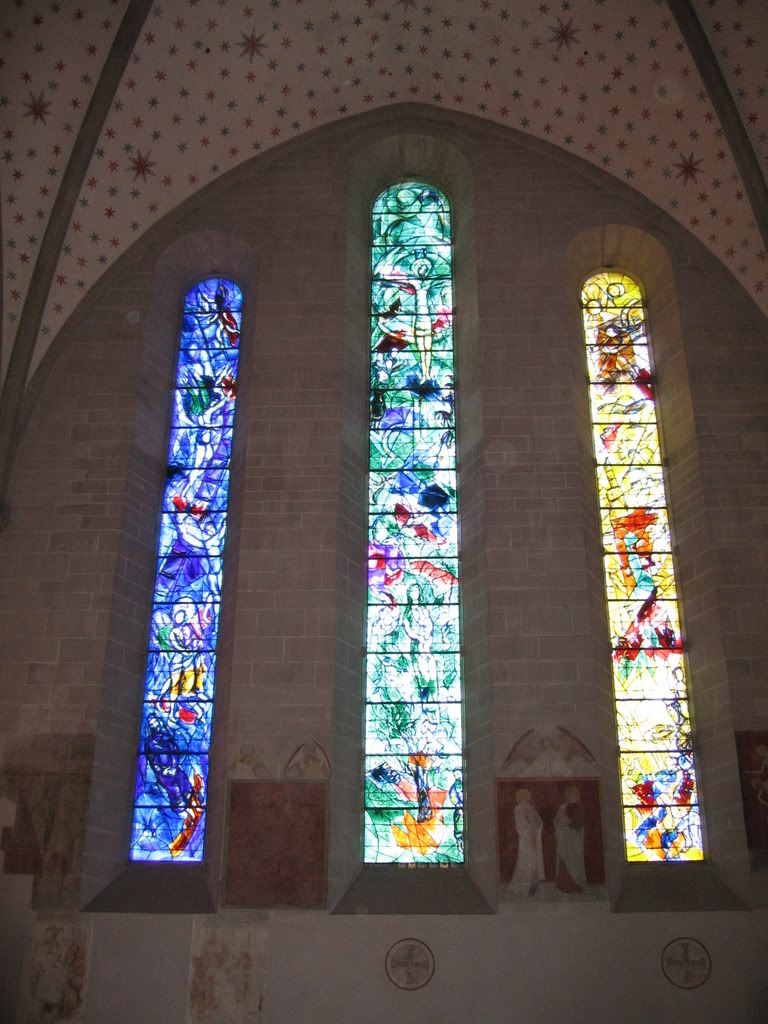
Another house of God that I entered long before I had an inkling that I would become a Christian is the Fraumünster in Zurich, a simple shell pierced by huge arrows of stained glass—bright, lithe and writhing images created by Marc Chagall. (See below) These houses of God were architectural gems, historical curiosities, museumlike collections of art.
At another shrine, Beethoven’s apartment in the Viennese suburb of Heiligenstadt, the matron said the great composer realized that he was going deaf when he could no longer hear the church bells ringing in that “Holy City.” For me, on the other hand, I never heard them ringing—until there was You. As in You, God. I began to recognize the holy characters, sacred scenes, lofty imagery in God’s many houses.
Yet God does not live only in the houses we build for God. The Celts have the thin place, where the veil lifts or even melts away between this world and the other. In Sedona, I explained thin places to Christine and, with a map indicating where to find the nearest vortex, she hiked high on the mountain and lay down to listen. She felt something special, intimate, a bit intoxicating.
And in all places—not magic but mystery, and very close: “Bidden or unbidden, God is present.”
 Allison Campbell Jensen
Leave a comment