We already knew ni ma “your mother.” Our Beijing tour guide just added the key word cao, because, he said, all Americans love to curse. Maybe the men had already learned it but I had not encountered this word until late in our weeks’ long study trip to the People’s Republic of China in 1980.
Last Sunday, The New York Times Magazine told us that on the Internet in China, 草泥马—“grass mud horse”—is a fool-the censors substitute for “a common insult that is unprintable in this magazine.” Gee, is that a common insult? I didn’t know. Maybe I’m hanging out with the wrong crowd.
Eavesdropping at 22, I filed this phrase in my mind as greedily as I did all the words, phrases, grammar—and experiences—I gathered during our brief sojourn in China. It had been only a year and six months since the United States had formally recognized the the government of the People’s Republic of China and, as a political science major in college, I was very eager to immerse myself into this long-forbidden country and delve into the workings of its socialist government.
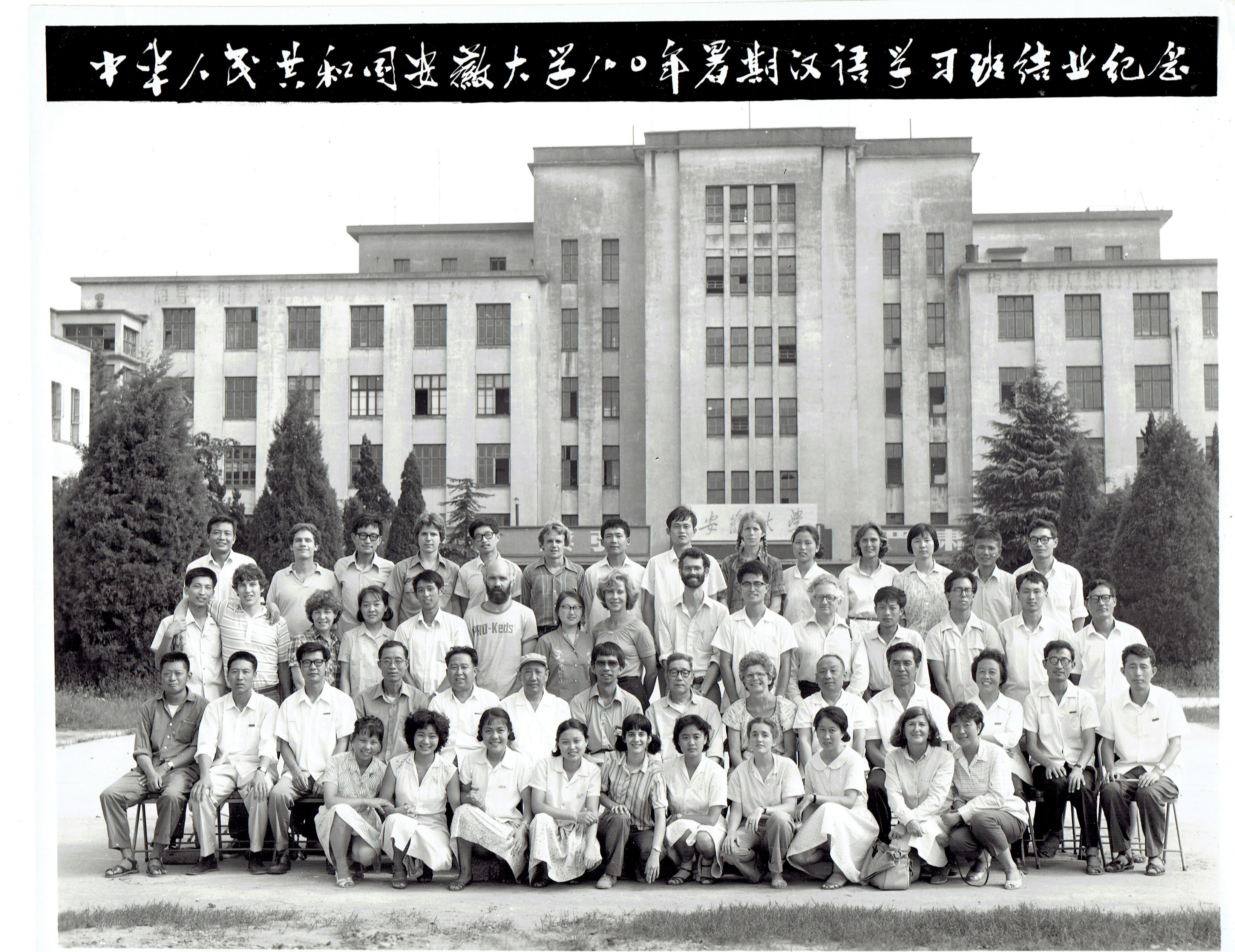
Our study group, comrades and teachers, Anhui Daxue, summer 1980.
Well, I learned some things. I saw bright aspects of life on the tea commune and in the fan factory that the trip leaders and party officials wanted us to see. And I also heard from Anhui University students shadowy stories of people being tortured during the Cultural Revolution and neighbors recording women’s monthlies to ensure they did not give birth to a second child and so violate the one-child policy.
Yet, most surprising to me among these New Men and New Women was a core of what I perceived as sweetness. About a week into our adventure studying in central China, my comrade, a female student about my height assigned to help me learn this tough language (and perhaps to keep an eye on me), asked: “Aren’t you homesick?” Surprised, I shook my head no. “But how do your mother and father feel about you being so far away? They must be crying!” Until then, I hadn’t thought about them perhaps missing me. So I asked her to take me to the post office, where I bought those lovely fold and seal Par Avion self-mailing letters and, in my tiniest scrawl, wrote to them about my days in China.
Thus I began to learn from a “heathen” Chinese a value that I would adopt as a commandment many years later, after I was baptized at age 40: Honor thy mother and father.
 Allison Campbell Jensen
My personal opening to China came in 1991. I was touched by the warmth and generosity of my Chinese hosts and coworkers. I remember walking down the street with my Chinese colleagues, one of each side, with their arms around me. And I remember the happy meals where they made sure I had the things I wanted to eat, by spinning the lazy susan around to put my favorite foods in front of me. My heart opened to them daily in numerous ways. As a youngster I was taught by my government to fear these people. Now I simply fear our governments instead. “Love your enemy” said Jesus. Funny thing, when you love your enemy you don’t have one…
Yes! I was going to mention the holding hands with comrades and other signs of affection but wanted to focus the piece. Did you see this essay? http://www.buzzfeed.com/mjs538/how-i-became-a-minor-celebrity-in-china-after-my#.pxD5ELJY7q Worth a read!