Bushwhacking, side-stepping, slipping down the mountainside through brush punctuated by spindly tree trunks, breathing hard from fear of bears, of unnamed threats, of being left behind.
A half-hour earlier on the glacier, Dad had plunged in up to his armpits; he’d dropped through a veil of ice into a crevasse. Hollering, he waved away my brother and me. He slowly pulled himself out of the crack and onto the ice field.
Then everything accelerated; suddenly, we were in a hurry to dismount this treacherous glacier in the Canadian Rockies. We rapidly changed from hiking Up the tongue of glacier toward a summit to going Down: any which way, as long as it was down. Dad and Richard consulted the map (I was 11 and, until seeing Dad nearly drop into another dimension, just happy to be in the high country with him and my brother). Single-file, we shuffled an icy path to the glacier’s pulverized rim of rock; up and over, then down the slope we walked and slid, bushes and trees snatching us from freefall.
Surprised by a flat path groomed out of the mountain’s side, we slop-stopped to catch our breath and our bearings. We were seeking Dad’s station wagon—but this wasn’t the trail by which we had come up the mountain. Which way? Another look at the map and we headed south, judging by the sun’s rays. We never carried a compass. By twilight, we arrived at the trailhead parking lot, relieved at being lost no longer.
Similarly by guess—educated perhaps, but still a guess—and by golly, my father strode, fell and slipped through life, breaking a path less taken so as not to be mistaken for ordinary. Never ordinary; following his lead was difficult, often exciting and seldom comfortable. To emulate his independence, I often went walking in the woods alone, spotting jack-in-the-pulpits, admiring tall Douglas firs and, one day, startling a deer. “What’s that human doing following my path?” she might have wondered, had she language.
Language and rhetoric and bravado—that’s what I absorbed in the summertime when my brother, sister and I would stay with Dad, long divorced from our mother. Arguing about politics around the dinner table; dismissing students who could not follow his lectures about philosophy (I hope he threw chairs at them only once); braving 50 years and his bulging belly by riding a motorcycle in the back country. The accident on a gravel road smashed his hands so badly that at least one pinkie could no longer bend. No more Brahms on the parlor grand.
And almost always he exuded seething disdain for anything he found mainstream and low-brow—rock stars, farmers (ranchers were different, somehow), wealthy people, businesspeople, Christians. This last group was blinkered from reality, reactionary in their politics, complacent with the world and self-righteous in their judgments. (Some media today seem to hold this view, too, taking loud-mouths and hate-mongers as representative of all Christians rather than individuals—and perhaps on the fringe). Worse, they were stupid. As children will, I absorbed his views, becoming as narrow as his depiction of the despised bourgeois God-lovers.
Breaking out of this constricted perspective took decades of my own sliding through life. After meeting a man on our 1980 guided trip to the People’s Republic of China whom I thought was not smarter than I, I applied to an Ivy League college for my graduate degree. Surprisingly, I was accepted and began meeting other smart people from around the country caught up in the recruiting net. My Dad told me it would be a crucible (“a place or situation that forces people to change or make difficult decisions”; I looked it up). One undergrad studying Chinese struck me as particularly down to earth; turned out, he learned a lot from working with the hands on his family’s ranch—one of the largest in Texas. Oh, okay; some rich people are all right, I thought. And well-mannered, too.
A few years later, working for a business magazine, I again and again interviewed interesting and intelligent men and women. Ours was a positive publication and I am not deceived: business has as many scalawags as other arenas of life. Yet so many people’s kindness and thoughtfulness opened my eyes to those in business who were not hateful and gouging, as my father would have it.
Later, after my divorce from my first husband—who like my father was an academic who didn’t want to treat his depression for fear his creativity would be stifled—I tried other directions. One was easy to slide into: accepted, comfortable and, ultimately, dark, pursuing gaiety through wine and fantasies of escape through men or miracles of money showers. After a while, I began to recognize that this path was so dark I couldn’t see the bottom.
I happened upon another, happier trail. In search of a nature story for the newspaper, I called the leader of a bird-watching trip at Hawk Ridge in Duluth. “Are you a birder?” he asked, his tone a bit suspicious. After a pause, I said brightly: “I like birds!” Yes, I found, I really love the birds and also really like the bird watchers (well, most of them). I fell for their close observations, their camaraderie, their constant seeking and their ability to unselfconsciously throw back their heads to put their binocs up to their eyes and study the sky.
Something in their seeking reminded me of two friends, Democratic Socialists from San Francisco who each deeply believed in Christ and were left-wing activists. I was intrigued in my 20s but still kept my distance (Did I think Christianity was contagious? Hmm, maybe I was on to something there). Could this species exist in Minnesota? One was Roman Catholic, the other Episcopalian. I began perching once in a while in Catholic churches—yet in these houses of the Great Mother Church, women were shunted to one side. Was my father’s dumping on organized religion and skepticism about professed God-lovers correct? Still, an atmosphere of prayer called to me. I flitted around until a birdwatcher-believer pointed me to an Episcopal church only blocks from my St Paul apartment. “You’ll like the music,” he said.
The red doors were opened to the breeze that summer day I slipped in the back and heard something I liked even more: the words of a priest dressed in a drab brown monk’s habit who spoke of pursuing justice in Central America. Wonderful—in that I wondered: Is this really religion? We can talk about real-life problems? Wow. (Believe, I know that some Christians would say it is not religion. But there you go: So many paths to God, to the Divine to enlightenment, as my Congregationalist colleagues have taught me.)
That fall, soft-spoken Father Bob was replaced by a fiery orator who practically hollered at us to take care of the poor and, in the name of Jesus, to fight for what’s right (and against the Right, as some heard it). He reminded me of Dad, a bit, yet opened up for me a new world of Christian belief and love. By spring, that priest of fire—later, I heard that Bill wore a flame-emblazoned cloak when he rode a motorcycle to his riverside ordination—had been doused and deposed but, fortunately for me, only after he had prepared me for baptism. Monkish Father Bob returned to baptize me in a bilingual Spanish-English Easter Vigil. “I’m envious that you are being baptized as an adult,” he told me before the mass, because unlike him as an infant, I would be aware of the meaning of the sacrament. Yet such a long road to arrive at this service, to begin this transition from stumbling alone to walking together.
This essential togetherness was brought home to me recently by John Dwyer, our priest at St. Christopher’s in Roseville. “As Episcopalians, when asked what we believe—which happens quite frequently—we can answer: Come worship with us. Come read our prayer book. For we are what we pray: Our prayers are our faith, our theology, our beliefs. Worshipping in community, saying all these prayers together, shouts out the importance of living together, of being in community. It allows us to say: We are the body of Christ in the world. We are telling all who will listen that the life and ministry of Jesus we are modeling directs us how to live our own corporate and individual lives. . . . That veil between heaven and earth is made more transparent, when the Word that is God, Jesus, and the grace and truth of his flesh and blood are made central to all that we do and all that we are. It’s so very simple . . . and so very complicated.” (Dec. 27, 2015 sermon, available on the church website.)
To join any Christian community, I felt I needed to be baptized. Dad, as he put it, had just not gotten around to it with us three kids. (To be fair, neither did our mother.) Gloria, the only one among his four (or is it five?) other wives whom I consider my stepmother, presumably took care of this for her five children. Hearing of my baptism, my mother confessed she had grown up going to the Congregational church in New England; first I’d heard that. My sister, who become a believer in her teens, said it was just the start of the journey. Oh, really? Yes.
My father had no comment at first; after a while, nasty letters began. Seven or eight years later, during one of our rare phone conversations, I dared to tell him about the social justice group I was working with at church. “I am proud of you,” he said. Surprised, I may have said, “Thank you.” Hanging up as soon as possible, I cried, quietly.
I didn’t want him to sense my emotion. I was the “toughie” among his six girls, the one who never cried, even while feeling lost in the Canadian Rockies. On that day split by a fall, we hiked a long way until we found the station wagon. I crawled into the back to lay down. The story is that, as my father drove farther and farther from bear scat and steep slopes, I slept for 24 hours. Perhaps I dreamt of another path—one wider, with guides along the way.
I was surprised again at Dad’s funeral, when a retired Baptist preacher revealed that my father talked with him many times about God. Turns out, Dad had been attending the Roman Catholic church in Ellensburg and was most recently worshipping with the Methodists. Once you start to slide, you may be surprised where you arrive. A month or so after his death, my sister mailed me his rosary and his rustic wooden crèche figures: at the center is Jesus, wonderful counselor.
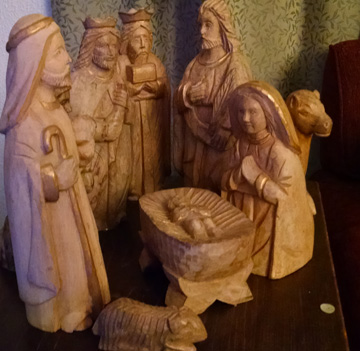
Coda: I find comfort but not complacency in this reflection from Bishop Steven Charleston.
“Walk the sacred way of your own heart, following where you believe you are led. Do not imagine that you are the first to pass this way, or that you have made the path for yourself. Have the humility to see the trail before you, even if the signs for it are few and far between. Remain true to where it takes you, even though it may be a steep climb. Do not fear that you will lose your direction, but be trusting in the holy guide that shows you where to turn. If you meet another walk together as long as you can, but if you walk alone then go in love for any who may follow. Stop to rest as often as you can and notice what is around you. Travel well, walk in peace.” From Arrows of Light: A Spiritual Diary, Red Moon Publications, 2015.
 Allison Campbell Jensen