Feeds:
Posts
Comments

Archive for August, 2019

“Wastin’ away again in Margaritaville
Searchin’ for my long lost shaker of salt
Some people claim that there’s a woman to blame
But I know it’s nobody’s fault . . .

“Yes and some people claim that there’s a woman to blame
And I know it’s my own damn fault.”

A song so famous, it even has its own website. Yet, for years, I had not heard Jimmy Buffet’s epiphany—that he owns his self-medicating-with-margaritas mess.

We have a mess to own, too, and it has to do with Hurricane Dorian battering the Bahamas and heading for the Carolinas. Climate change means Dorian and other tropical storms, fueled by warming ocean waters, are becoming more intense and more frequent. Along with empathizing with the suffering, we need to think about our contribution to these disasters. “People are busy taking cover now, but ultimately we must act more broadly and more proactively for the long term,” former NASA science editor Laura Tenebaum wrote Sept. 1 in Forbes.

By we, I mean those of us who are financially comfortable enough to have choices. How about our transportation choices? My family can choose whether to drive or to fly for long trips. Although, as much as we love our cars, at times a person cannot drive—climate activist Greta Thunberg avoided the high carbon cost of flying and hitched a ride across the Atlantic Ocean on a stripped-down racing yacht. She and the team sailed from Plymouth, England, to New York City in 15 days.

That’s a lot of time! For a typical trip from Minnesota to visit my family and friends in the Pacific Northwest, arriving within a few hours or spending days on the road is the choice. Even the Empire Builder takes a couple of days—although, unlike in a car, passengers can walk around the train as they watch the beauty of the High Plains give way to the Rocky Mountains and the rolling fields of Eastern Washington carry them to the Cascade Range.

This morning, I choose to ride my bicycle to meet my friend Fran for a birding walk. We’re meeting not far from my home; it’s not raining; the temperature is about perfect—the choice is easy.
Some choices for the future of our planet, our island home, are easy. Turning off lights should be, although it seems that this easy step can be hard to remember, judging by the number of times I turn off lights I find on in unoccupied rooms. I’m not the only one: Harold at church, an older person with a good measure of wisdom, remarks about folks wasting money as he walks around flipping switches off in empty rooms. We don’t all have a Harold (or an Allison) following after us. Please consider this easy step to save energy, save money, save the planet: When you’re done, turn off the lights.

Many of the choices we can conceive, as we person up for the planet, are less easy. Consider cooling and heating our homes, our offices, our churches, our city buildings: there’s this feedback loop (“The air conditioning trap,” The Guardian, Aug. 29, 2019). “[W]armer temperatures lead to more air conditioning; more air conditioning leads to warmer temperatures. The problem posed by air conditioning resembles, in miniature, the problem we face in tackling the climate crisis. The solutions that we reach for most easily only bind us closer to the original problem.” Living in a cold (albeit warming) climate, I’m aware that we use a lot of carbon-heavy energy to heat our indoor spaces, too.

So, please, when you are the last person to leave the room, turn off the lights. And, while seeing the news about hurricanes, before pouring more margaritas, think about your everyday choices that could lead to a better future of the planet, even if they are a bit more challenging.
Read Full Post »

In March, a story about Minnesota Twins player Bryon Buxton “carrying more bulk, moxie” caught my eye. During the off season, Star Tribune’s Jim Souhan wrote, Buxton “would wake early, eat two 8-ounce steaks and a dozen eggs, work out, then repeat the meal. He consumed 10,000 calories a day so he can hit balls over walls and survive encounters with them. ‘Easy to say,’ Buxton said. ‘Hard to do. I’m not scaling back, not going to avoid running into walls. I put on 10 pounds for a reason. The walls got me the last few seasons.’”

Me, I’m not a professional athlete. What I am is a 61-year-old who probably has spent more time chewing the fat about food than many, because I am often the family cook, because of occasional worries about calories and, because I like to eat well, I think about food several times a day, every day.

I know that food carries baggage—family, culture, trends, emotions and carbon. You may have heard the news in early August that a “United Nations panel says countries around the world need to adapt food systems to limit climate change, including adopting more sustainable agriculture practices and altering diets to eat less red meat,” ABC reported. “Agriculture and other uses of land around the world contribute more than 23% of greenhouse gas emissions, according to the report and warming from climate change could start to make food more expensive as heat, drought or extreme rains make crops less productive.” How we feed ourselves relates to the climate crisis, which is transforming our planet.

The Amazon is burning up and we are rightly fired up but frustrated. It’s hard to know what to do to help. Yet, as agriculture has been cited as one of the reasons that the huge Amazonian rain forest is under threat, my suggestion is to look to our own eating habits. Here are five things we can all do to reduce our food-associated carbon footprint.

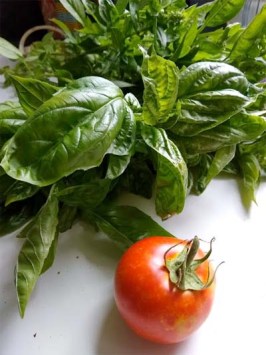
First: Don’t waste food.Basil.8.24.19

Second: Pause, think, plan ahead.

Third: Buy, eat, drink locally.

Fourth: Grow flowers and bushes and trees for pollinators. 

Fifth is the big question, for us carnivores: How about those steaks that Buxton was chowing down to bulk up? Do we have to give up beef?

First: Don’t waste food. Did you know that 40 percent of the food in the United States goes from farm to trash can (or, we hope, compost bin)—uneaten? This statistic was shared by Vice President Al Gore while he was interviewing agricultural experts during the Climate Reality Project Leadership Training in Minneapolis Aug. 2-4, 2019. As you can imagine, that figure also means wasting 40 percent of the inputs, like people power (labor and intellectual resources) and fossil fuels used for farm equipment, transportation and packaging.

Buy less food; eat your leftovers; and put your unsalvageable food waste in the compost. (Thanks, Michael Pollan and Ginger Pinson!)

Second: Pause, think, plan ahead. Take the long view. In the great state of Minnesota, our winters can seem long—okay, they are long. In the darker months, finding fruits and vegetables that haven’t made the long, greenhouse-gassy trip from the Southern Hemisphere? Challenging.

Yet our sister-in-law in Washington State harvests basketfuls of blueberries in season and has a freezerful for her year-round breakfasts. We not only have cherry pie from our backyard tree, I also make jam. Edmond, in Minneapolis, has transformed most of his yard into a vegetable garden. His adventures in putting up food include a panoply of pickles.

I have other ideas. How about you?

Third: Buy, eat, drink locally. Do I have time to get to the farmer’s market this Saturday? Do I have to drive? Could I go on my bike? On the Green Line? Could I combine my usual three grocery trips a week into two? How about going out? Where should we go for lunch? The “freaky fast” place across the street? Or the co-op that offers mostly locally grown foods? Shall we go out for a drink? How about a local brewery? How far do we have to drive to get there? Could we bring some friends and share the carbon?

Fourth: Grow flowers and bushes and trees for pollinators. Everything is connected—we need to feed our insects, not only the charismatic honeybees but also all the others—so that they can pollinate our foods. My cherries, sweet corn growing at the U of M’s St. Paul’s campus, the tomatoes in our church Giving Garden—they all need the “services” that pollinating insects provide. And that’s just in my neighborhood!

Fifth is the big question, for us carnivores: How about those steaks that Buxton was chowing down to bulk up? Do we have to give up beef? Well, according to Project Drawdown, which offers 100 positive solutions to address the climate crisis, it depends on how the cattle are grazed. “Where original grasslands are still intact, they are abundant lands with carbon-rich soils. They benefit from the activity of migratory herds that cluster tightly for protection; munch grasses to the crown; disturb the soil with their hooves, intermixing their urine and feces; and then move on.”

Earth-friendly managed grazing practices rank #19 on the drawdown.org list. If implemented, managed grazing would cost $50 million, saving $735 million and keeping 16.34 gigatons of carbon out of the atmosphere by 2050.

But what about methane from those cattle? Well, contrary to popular myth, they don’t fart methane, they burp it, said Jonathan Foley, Director of Project Drawdown, during the Climate Reality Project Leadership Training. Either way, it appears that they are having some trouble digesting their feed. Maybe if, instead of corn, they grazed on the grasslands they’ve adapted to over thousands of years of husbandry, they’d burp less?

Anyway, to me, grass-fed beef tastes better. I eat not only to fuel my body but also to enjoy my meal. So, what’s for dinner?

Read Full Post »

On the Move

Walking inside a giant Tupperware bowl, I could not see the mountains to the north of Pasadena. The air pollution was so bad in 1990 that a day clear enough to see Catalina Island from Griffith Park rated a big photo on the front of the in the Los Angeles Times metro section. This was news, folks! Drive-by shootings didn’t make the front of that section that year–unless a child was killed by gunfire.

My asthmatic first husband would walk the mile from his work on the Cal Tech campus to our apartment, then lie down for a half hour to regain his breath. When I would walk to the library, people driving their cars would stare at me. All those people and yet I felt a little lonely on those empty sidewalks.

I hear the skies have cleared in the Los Angeles basin because of stricter emissions controls on cars. That’s good news. The bad news is, in Los Angeles and Paris and Mexico City and Beijing and the Twin Cities, we are putting 110 million tons of manmade global warming pollution into the atmosphere every single day. Al Gore, founder of the Climate Reality Project, Nobel Prize recipient and former Vice President of the United States, shared this fact as he trained new Climate Reality Leaders like me at a recent meeting in Minneapolis. Greenhouse gases, unlike the Los Angeles smog of nearly 30 years ago, are not visible to the eye.

Gah! Given the scale of this global climate crisis, what can an individual like myself do?

Well, I can make choices–on my commute, at the grocery, when I am traveling. Perhaps you’ve heard that Greta Thunberg, the brave Swede who is leading a global student movement to fight the climate crisis, is traveling by sail from Europe to America specifically to avoid the carbon costs of air travel. It’s not cushy, sailing on a yacht built for racing–creature comforts came last in its design. Yet she is living by her principles, which is why she is such a powerful leader.

Every day, I have the chance to make a small difference for the planet. A couple of days ago, I was going to the garage to get a vehicle for a trip. Playing with his bicycle in the driveway, grandson Presley said, “Oh, I will get out of your way.” “No worries,” I replied. “I am taking my bicycle.”

Love your planet. Make choices to counter this climate crisis. Take your bicycle, take the bus, eat locally (when possible) and, yes, think globally. The generation that includes my grandson? They are watching and learning.

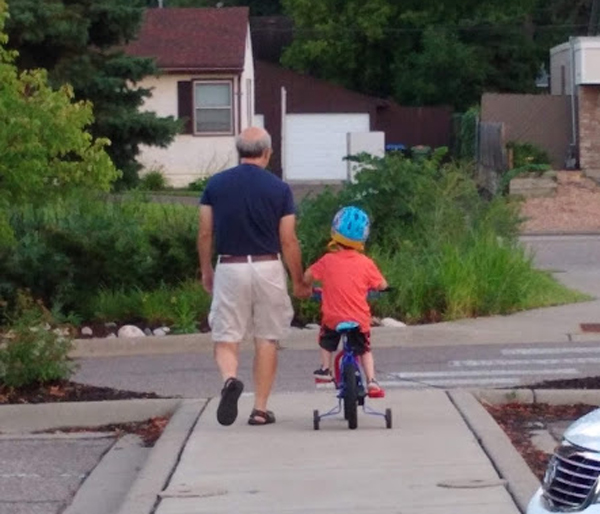
Image: My husband and grandson leaving the Roseville library on Tuesday evening.

Read Full Post »

The House Wren’s staccato chatter–“my yard . . . my flowers . . . my bugs”–scolds me as I roll my bicycle from the garage. “My home,” I think to myself, even though I’m very glad to share with avian friends. It’s a sunny, glorious morning to bike to work, blue sky dotted with white clouds, a field of corn seemingly breathing as it grows on the St. Paul campus of the University of Minnesota, with only a light breeze to cool my sweat.

I’m pedaling hard so the nine miles go by fairly swiftly, past prairie grasses growing beside railroad tracks, the red sandstone Romanesque Pillsbury hall on the U of M’s Minneapolis campus and, of course, the powerful Mississippi River–still majestic even spanned by bridges and slowed by dams.

Starting the last mile, I ride up into downtown Minneapolis: autos, food trucks, buses. Oh, my! I’m not lollygagging but I’m not impatient as I wait for the light to change while sitting on my bike next to a yet another construction site at the intersection of Nicollet Avenue (buses and bicycles only) and 3rd Street. That turns out to be a good thing. The light turns green, I start to cross, and a black sedan whips in front of me, running the solidly red light! (license plate 81 032, state of Virginia, I think–I was a little verklempt).

While I had probably the cushion of several feet of pavement, so we were not in danger of an immediate collision, I am not armored. Oh, my beating heart! When she drove by me so fast, it came home to me how vulnerable I am on my bike in traffic. This leaving home is a risky business!

We all face another risky business, the climate crisis. We may be pedaling or driving or toodling along, not yet aware of how vulnerable we and our fellow creatures on this planet. On a glorious morning in Minnesota, one can feel complacent. We cannot perceive greenhouse gases rising at precipitous rates in that clear sky, which is a relatively thin envelope. Actually, we need atmospheric scientists to help us with those measurements–and they tell us we have hit historic high levels of greenhouse gases and the globe has experienced the five hottest years on record.

Yet there’s good news, too! I and eleven hundred of my new friends recently learned from Climate Reality Project founder and Vice President Al Gore that every hour the Earth gets as much energy from the sun as we need to run the entire global economy for a year. If we can increase the fraction of that solar power we harvest and use, we can make a lot of progress towards solving the climate crisis and helping local economies at the same time.

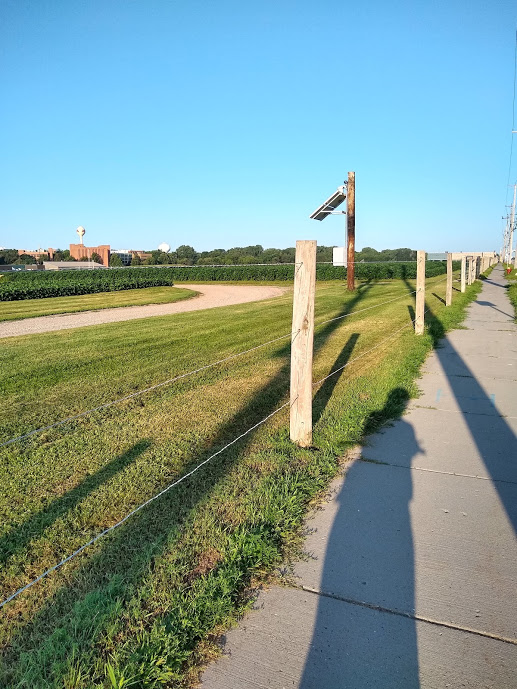
So thank you to everyone who installs solar, including my St. Christopher’s Episcopal Church (yay, Green Team!), the U of M–the photo shows a solar panel on the St. Paul campus (#UMNproud)–and my brother and his wife in Olympia, Washington. After all, we are not leaving this island home, our fragile Earth, anytime soon.

Read Full Post »