While he was still Bob—not yet Dad—he loved the water, swimming in Lake Michigan. Later, as Dad, in the summer he might take a couple of his kids when he would meet his friends to float down the Yakima River in inner tubes. And, whenever the world got to him, if he wasn’t holed up in his study, he was soaking in hot water in a deep clawfoot tub.
Our Dad, known outside the home as Dr. W. Robert Goedecke, professor of philosophy, spun for us many tales, arising from sources like Yakima Nation lore to Claude Levi-Strauss’s analysis called Structuralism to Aristotle’s teachings to the thinking of Heraclitus. The latter, who lived in Ephesus 530-470 BCE, famously said you can’t step in the same river twice. (Well, that’s one interpretation of his line “We both step and do not step in the same rivers. We are and are not”: See Philosophy for Change for details.)
I liked that saying about the world constantly changing—and each of us changing as well so that moment to moment we are different. So, I embroidered for Dad a piece that declared: “You can’t float in the same river twice.” I was 13 and unschooled in handwork—the river was bright blue thread in a clumsy chain stitch, the lettering a bit shaky. But he liked it and tacked up the postcard-sized piece of muslin on his bathroom wall.
Now, his eight children live in a variety of places around this beautiful country—each near water. From eldest to 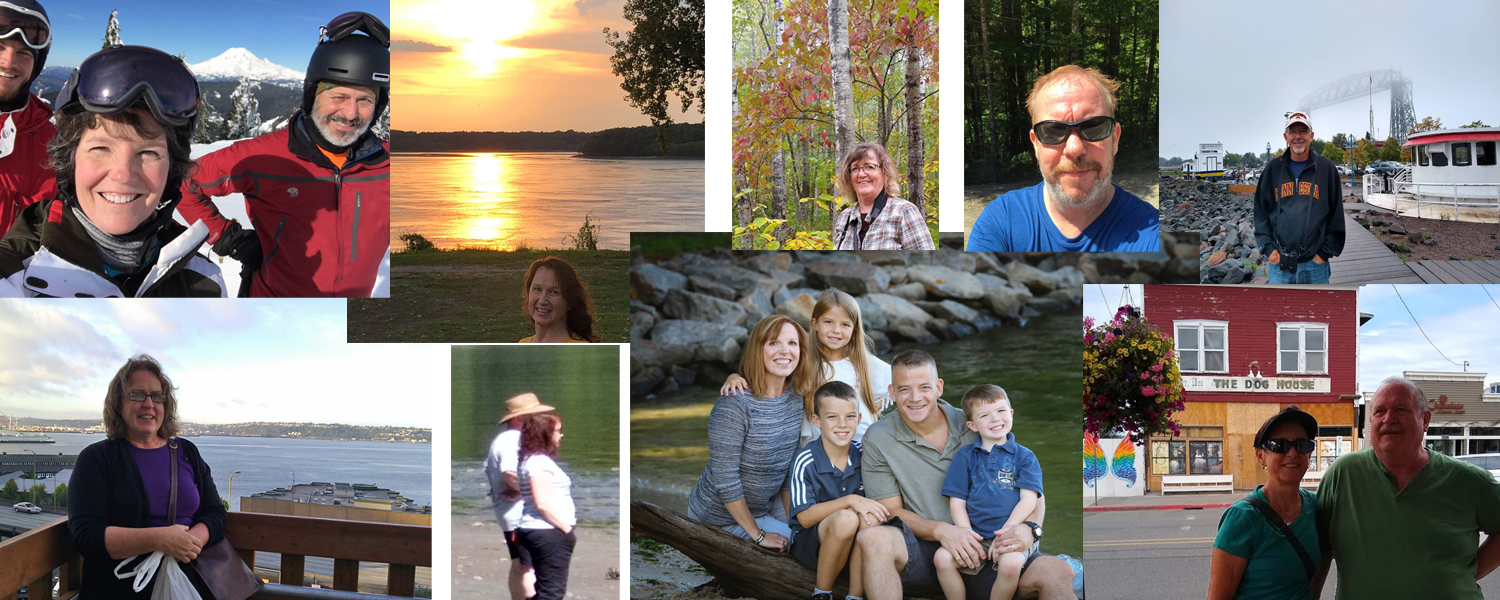 youngest: Richard lives not far from Puget Sound; Anne, the Yakima River; Allie (me), the Mississippi River; Tracy, the Cowlitz River; Stephanie, Puget Sound; Trish, the Mississippi River; Bobby, the Willamette River; and Lori, the Connecticut River. Water unites us along with family ties.
And so it is with the great human family: water unites us; living together on this beautiful, threatened planet unites us.
Yet, feeling united can be tough. A colleague told me that people evolved in small groups, up to maybe 50 people. In these ancient human groups, they all knew each other, trusted each other and, when someone broke the mores of the group, they all knew it. Now, he went on, we live and work and worship in, some cases, much larger groups—and, given our ancient precarious way of life, which lives on in our deep brain, we tend to be distrustful of those outside of our immediate family or affinity group.
Gee—that distrust is a huge barrier to overcome if we want to join together to turn our global, national and regional habits and practices toward a direction that will address and perhaps even (in the long term) reverse climate change. How can we change? After all, the news about climate change, the greenhouse effect, global warming, global weirding—none of this is new.
What seems to be changing is the focus: That this climate crisis is real and involves and affects all of us. We are beginning to wake up, whether because we are really listening when young climate activist Greta Thunberg schools the U.S. Congress to trust the science or we are barred from one of our most popular state parks in Minnesota by high water from March until now or we know people living through tropical storms threatening islands and coastal cities (Hurricanes Maria, Harvey, Dorian and the recent aptly named Depression Imelda—I’m talking about you. Why do we personify storms by giving them names, by the way?).
We are recognizing that our world is changing and we play a role in it. During the climate strike Sept. 20, an estimated 4 million took to streets around the world to demand change. That’s hugely important.
Also important: Each of us makes choices every day that move the future in one direction or another. Be intentional and consider these changes:
- Drive less—combine trips, ride a bike, take a bus.
- Find out if your retirement funds are invested in oil companies—and divest.
- Buy enough but not too much food—don’t waste food or, if you have too much, compost it.
- Check out Project Drawdown for 100 climate solutions, with the science explained.
And, like Dad, return to the water that we all share and revel in it. I didn’t live with Dad much as an older child but Tracy tells me that Dad “sometimes did the back and forth from very hot to very cold, from scalding bath to ice added to the kids wading pool on the patio, or out into the snow in the winter” in a manner related to American Indian sweat lodge practices, to gain clarity.
Body and soul and heart and mind—all are related as we seek to lead on climate. I’m in—how about you?
 Allison Campbell Jensen