What is the Golden Rule? the teacher asked us. The other kids in my second-grade class were silent, momentarily stilled, so I piped up: “Stop, look and listen.” Um, this was not the rule she was looking for at the time, although not a terrible choice.
“Stop, look and listen” is what we did Memorial Day weekend 2019, tooling around the southwest corner of Minnesota—we being me, my husband, trip leaders Kim Eckert and Craig Mandel and 20 birder friends. One morning, our car stopped for a meadowlark, perched on a fence post. No doubt we listened because that bird’s song could determine the answer to the usual Minnesota birder question: “Is it an Eastern Meadowlark or a Western?”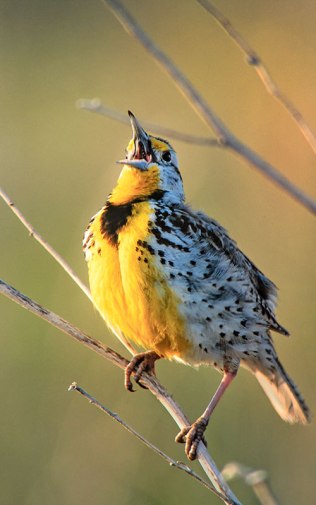
Yet did we pause a bit before the usual question was asked? Perhaps to admire the dapper V embellishing his yellow breast? Or perhaps, even before categorizing the species, to enjoy his sweet song? It’s “the sound of the prairie,” according to renowned photographer Jim Brandenburg. (The photo of the meadowlark is his, taken in Brandenburg’s original stomping grounds near Luverne.)
Perhaps we stopped a little longer than usual because there are fewer of our Meadowlark friends to look at and to listen to—half the numbers that birdwatchers spotted in the 1970s. They are among the nearly 3 billion birds that have disappeared in recent decades, according to the Cornell Laboratory of Ornithology.
On this Minnesota Birding Weekend, we also stopped to look at a family of Swainson’s Hawks near Touch the Sky Prairie, which Brandenburg helped protect. Because one person thought he spotted a Common Loon, a small group of us stopped by ponds next to a gravel road in southern Rock County. The landowner drove up on his ATV to find out what we were up to; those ponds had been his gravel pits two years ago. All the unrelenting rain had filled them. We stopped on a rural road in Jackson County because so much rain had been falling that a one-time pond fattened into a lake, closing the road.
It was clear in late May that a lot of fields intended for corn and soybeans had not yet been planted. This fall, with the state heading for a new record annual rainfall, I wondered what had happened, so I wrote to the Extension office in Rock County. “This has been a rough year for farming,” Lizabeth Stahl wrote back Oct. 9. Almost 9.5 percent of the farm fields were not planted, she wrote—those can be claimed for insurance purposes, however—and most were planted later than usual because of all the rain. “It will be a long, late harvest, and farmers are looking at added costs to dry corn since we are running out of time for the crop to dry down in the field before harvest.” Commodity prices are poor, she added; “this will be a year hopefully we don’t repeat!”
Unfortunately, this ill weather likely will repeat because scientists figure the overwhelming rainfall this year in Minnesota is part of the pattern caused by global climate change. California is burning up right now, which is insistently connected to the climate crisis. And in Minnesota, the climate crisis is right here, too, flooding basements in the Twin Cities and super-soaking fields in southern and western Minnesota.
“Well, is that my problem?” you might ask. Yes, it is. It’s our problem because all of us contribute to the greenhouse gases in our atmosphere. It’s our problem—and it’s one we can address with better choices. The Cornell Lab offers seven simple actions to help birds; to help our planet, I urge you to consider additional choices.
- Change how you get around: Drive less; carpool; bicycle; walk; take public transportation; when it comes time for a new car, choose a low- or zero-emissions vehicle.
- Change what you eat: In the United States, 40 percent of food goes to the landfill—wasting the fuel, land used and human intelligence used to produce it and bring it to market. Lean toward a plant-rich diet, with less beef (or grass-fed beef), if possible. Find out where your food comes from, because locally grown has a smaller carbon footprint.
- Change your spending: Follow the money—your money—and ask pension fund managers or financial advisors to extricate your retirement funds from fossil fuels. Big Oil might not care—not right away, certainly—but you will be investing consistent with your values, which just makes sense.
Years ago, in that second-grade classroom in Parsons, I learned that the Meadowlark is the state bird of Kansas. We also sang Home on the Range, celebrating a state “where seldom is heard a discouraging word, and the sky is not cloudy all day.” Discouraging words are not what we need, facing a world in crisis; we need to learn more, together.
That’s what happened when I and 1,100 of my new friends participated in the August Climate Reality Project training. Vice President Al Gore’s presentation was riveting, even at 2.5 hours and more than 600 PowerPoint slides. The other presenters included so many standouts, from Dr. Jonathan Foley of Project Drawdown to Mayors Jacob Frey and Melvin Carter, who are committed to a clean-energy future for our Twin Cities. Now as a trained Climate Reality Leader, I have committed to #LeadOnClimate—and all of us have access to all of Vice President Gore’s amazing slides.
So even bookish types like me find there is a time when I need to put down the books (although Climate of Hope is an uplifting, practical one, by Michael Bloomberg and Carl Pope) and put aside the phone (The Guardian and Yale Climate Connections are great sources of information). I and we need to get into the fray. Let’s talk with our neighbors; let’s write or call our policymakers; let’s choose ways to live that will make a difference for our future. You are invited to hear award-winning environmental activist Rev. Ashley Bair and me at our Nov. 20 presentation on the Climate Crisis and its Solutions. We’re two of myriads of Climate Reality Leaders around the globe presenting Nov. 20–21, 2019, during 24 Hours of Reality: Truth in Action.
Why are we doing this? Because whether you live in California or Minnesota, Vietnam or Portugal, Brazil or Qatar, as Greta Thunberg says, “Our house is on fire.” What is the Golden Rule? Now, many years later, I know: “Do unto others as you would have them do unto you.”And those others, I suggest, include not only our fellow humans but also the bears, the bugs, the birds—the meadowlark—all our companions on this fragile Earth, our island home.
 Allison Campbell Jensen