Feeds:
Posts
Comments

On the Move

Walking inside a giant Tupperware bowl, I could not see the mountains to the north of Pasadena. The air pollution was so bad in 1990 that a day clear enough to see Catalina Island from Griffith Park rated a big photo on the front of the in the Los Angeles Times metro section. This was news, folks! Drive-by shootings didn’t make the front of that section that year–unless a child was killed by gunfire.

My asthmatic first husband would walk the mile from his work on the Cal Tech campus to our apartment, then lie down for a half hour to regain his breath. When I would walk to the library, people driving their cars would stare at me. All those people and yet I felt a little lonely on those empty sidewalks.

I hear the skies have cleared in the Los Angeles basin because of stricter emissions controls on cars. That’s good news. The bad news is, in Los Angeles and Paris and Mexico City and Beijing and the Twin Cities, we are putting 110 million tons of manmade global warming pollution into the atmosphere every single day. Al Gore, founder of the Climate Reality Project, Nobel Prize recipient and former Vice President of the United States, shared this fact as he trained new Climate Reality Leaders like me at a recent meeting in Minneapolis. Greenhouse gases, unlike the Los Angeles smog of nearly 30 years ago, are not visible to the eye.

Gah! Given the scale of this global climate crisis, what can an individual like myself do?

Well, I can make choices–on my commute, at the grocery, when I am traveling. Perhaps you’ve heard that Greta Thunberg, the brave Swede who is leading a global student movement to fight the climate crisis, is traveling by sail from Europe to America specifically to avoid the carbon costs of air travel. It’s not cushy, sailing on a yacht built for racing–creature comforts came last in its design. Yet she is living by her principles, which is why she is such a powerful leader.

Every day, I have the chance to make a small difference for the planet. A couple of days ago, I was going to the garage to get a vehicle for a trip. Playing with his bicycle in the driveway, grandson Presley said, “Oh, I will get out of your way.” “No worries,” I replied. “I am taking my bicycle.”

Love your planet. Make choices to counter this climate crisis. Take your bicycle, take the bus, eat locally (when possible) and, yes, think globally. The generation that includes my grandson? They are watching and learning.

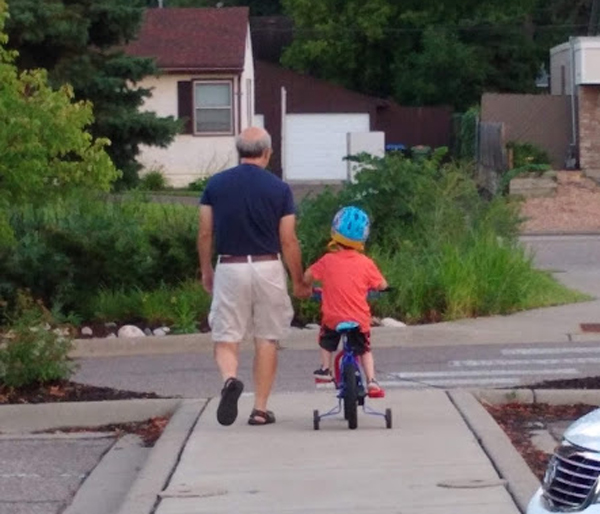
Image: My husband and grandson leaving the Roseville library on Tuesday evening.

Leaving Home

The House Wren’s staccato chatter–“my yard . . . my flowers . . . my bugs”–scolds me as I roll my bicycle from the garage. “My home,” I think to myself, even though I’m very glad to share with avian friends. It’s a sunny, glorious morning to bike to work, blue sky dotted with white clouds, a field of corn seemingly breathing as it grows on the St. Paul campus of the University of Minnesota, with only a light breeze to cool my sweat.

I’m pedaling hard so the nine miles go by fairly swiftly, past prairie grasses growing beside railroad tracks, the red sandstone Romanesque Pillsbury hall on the U of M’s Minneapolis campus and, of course, the powerful Mississippi River–still majestic even spanned by bridges and slowed by dams.

Starting the last mile, I ride up into downtown Minneapolis: autos, food trucks, buses. Oh, my! I’m not lollygagging but I’m not impatient as I wait for the light to change while sitting on my bike next to a yet another construction site at the intersection of Nicollet Avenue (buses and bicycles only) and 3rd Street. That turns out to be a good thing. The light turns green, I start to cross, and a black sedan whips in front of me, running the solidly red light! (license plate 81 032, state of Virginia, I think–I was a little verklempt).

While I had probably the cushion of several feet of pavement, so we were not in danger of an immediate collision, I am not armored. Oh, my beating heart! When she drove by me so fast, it came home to me how vulnerable I am on my bike in traffic. This leaving home is a risky business!

We all face another risky business, the climate crisis. We may be pedaling or driving or toodling along, not yet aware of how vulnerable we and our fellow creatures on this planet. On a glorious morning in Minnesota, one can feel complacent. We cannot perceive greenhouse gases rising at precipitous rates in that clear sky, which is a relatively thin envelope. Actually, we need atmospheric scientists to help us with those measurements–and they tell us we have hit historic high levels of greenhouse gases and the globe has experienced the five hottest years on record.

Yet there’s good news, too! I and eleven hundred of my new friends recently learned from Climate Reality Project founder and Vice President Al Gore that every hour the Earth gets as much energy from the sun as we need to run the entire global economy for a year. If we can increase the fraction of that solar power we harvest and use, we can make a lot of progress towards solving the climate crisis and helping local economies at the same time.

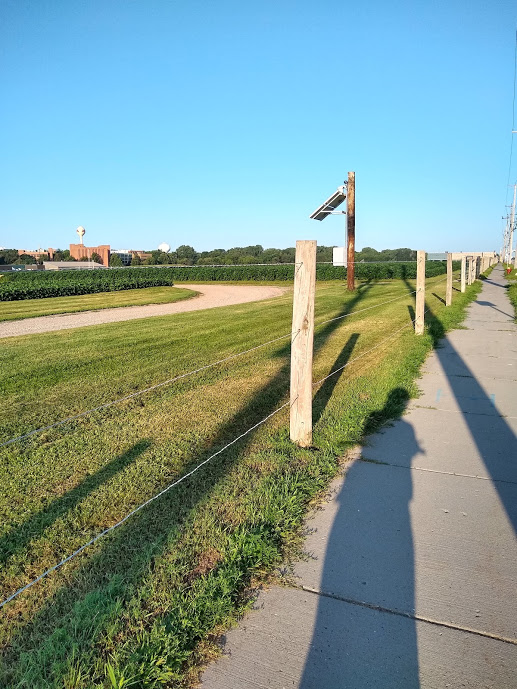
So thank you to everyone who installs solar, including my St. Christopher’s Episcopal Church (yay, Green Team!), the U of M–the photo shows a solar panel on the St. Paul campus (#UMNproud)–and my brother and his wife in Olympia, Washington. After all, we are not leaving this island home, our fragile Earth, anytime soon.

The rainbow hung low, skimming the horizon, as the bus roared up the hill on Hwy. 36. Did anyone else see it, engrossed in the content on their phones?

Don’t misunderstand, please: Believe me, most days commuting home, that would be me, but yesterday I was rainbow_and_turbines.jpgtoo tired, after a work day of looking at a computer screen. Maybe the driver? He might have seen it, too. He wasn’t as challenged as typically because traffic levels were light because we’re in Minnesota, the day before the Independence Day holiday begins, and everyone who has a cabin (or a relative with a cabin) has left for The Lake. That cabin is typically Up North, BTW, if you’re not from here.

Resisting the urge to shout “Hey, look at that rainbow everybody!” I sat back and took it in: The reminder that God put a rainbow in the sky after the Flood receded as a sign that God would never again destroy the Earth. A rainbow is a sign of covenant, of promise, of love–and now, a sign of God’s love for everyone, as rainbows today can evoke the embrace of all people, any orientation (or not), any color, any nationality . . . anyone and everyone.

Long before I was a Christian, I was always chasing rainbows. As my mother loved a colorful sunset and hated to miss seeing one, I was and am overjoyed by rainbows. Still unclear on the physics after 61 years on the planet, I do know to look for them when the sun is shining after a rain. What a metaphor! What beautiful gifts to us from our home, Planet Earth! As I read today in a Happy Interdependence Day post: “

According to my and most people’s understanding, this planet came into being with all its life forms and creatures over millennia. But that doesn’t preclude God acting in the world, at least within my understanding of God. And while God has promised not to destroy the Earth, God gave humans free will. If we don’t check our impulses and intentionally change our habits, we are on a path to destroy this beautiful Earth, our island home.

There is no Planet B. Let’s love the Earth–and each other.

Sisters in Seattle

Indigo Girls? Heard their name before and had an inkle they are woman-centered; went to Google and found them appealingly folky. And, really, when one of your sisters offers you a free ticket to a concert, why turn down the opportunity to go hang with as many of the six as show up?

Even though the concert is in Seattle—and I live in Roseville, Minnesota? But Lori lives even farther away, in Connecticut, and Trish lives in Memphis. Steph and Anne have to travel from Olympia and Ellensburg, Washington, respectively. And the hostess, Tracy, lives high in the Cascade Mountains, very close to Mt. Rainier.

Physical distances aside, we had psychic landscapes to travel. Issues and fights during our teenage years and later, disappearances from each other’s lives, competition for love from a not terribly tall yet towering father—the dark side of the past.

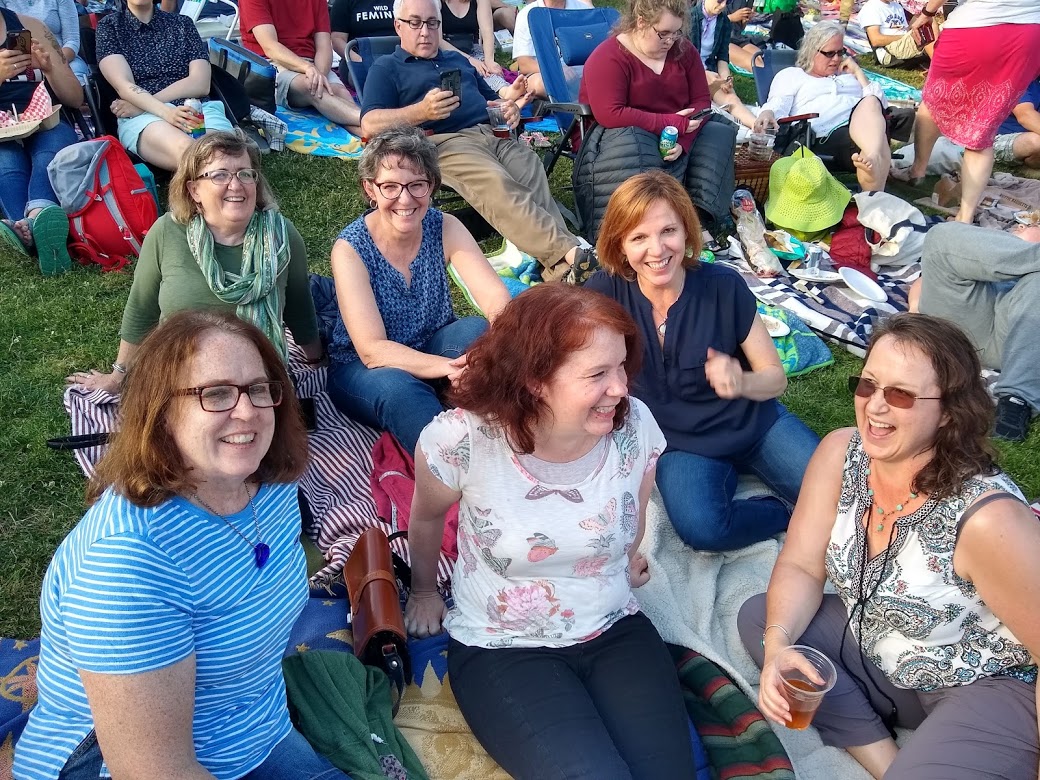
Sunshine and happiness and 13 years since Dad’s passing banished all that on Father’s Day 2019. We created our space by layering blankets together on a just-right afternoon in Woodland Park Zoo, sometimes listening to the music, watching a little boy dance and pick up partners passing by, and talking, talking, talking.

If you happened to be sitting near us, sorry: we have a lot of threads to pick up and weave together.

Mostly, although he was the unseen guest, we did not talk much about Dad, our Professor of Philosophy father. (BTW, we also have two brothers.) He had brought us together. Walter Robert Goedecke: “My God, what a difficult man,” said Judson at his funeral and we all laughed in recognition. All except perhaps the tiny lady in the wheelchair who listened to everything later at the wake and then popped up with this: “I don’t know why you are saying all these terrible things about Bob. He used to come around on Sunday afternoons, pick me up and take me for rides in the country. He was very kind.”

“To me,” she should have added, I think. In the later years of Dad’s life, I asked my husband to open his letters, in case he had written anything I might want to read. Mostly, they went right into the recycling: So much vitriol. Dad and I had started corresponding when I was a kid, after the divorce. Unless the mice have digested all the lovely words from the era before I married a man he didn’t approve of, I have years and years of letters, sitting in a box in our garage attic.

(About a month before he died, Dad and I had a rare phone conversation. When I told him about the social justice work I was doing with my church, he said, “I am proud of you.” After I hung up the phone, I sobbed—having been a disappointment for decades, I had waited so long to hear those words.)

So much depends on perspective. In 2019, 13 years and a few months after Dad’s funeral, we range in age from our 40s to our 60s. We have been snatching snaphots of each others’ lives, our families and friends on Facebook, some seeing each other IRL, me in the country’ middle, not so much.

From a distance, we have adored Ben and Josh, Anne’s grandsons who appear to be very different in character and very close as brothers. We have prayed in our various ways for Lori’s Jake (he’s fine now, thanks!) and sprouting siblings Avery and Max; admired Tracy’s adventuresome Leanne and forthright Oliver and her four other wonderful and good-looking children; and (I like to think) found my grandson Presley cute. On Facebook, Steph appears the most restrained—but when she posts, she always is trenchant and thought-provoking. And Trish? She has a Facebook group on the Meaning of Life.

The Meaning of Life: no small topic! When I received a copy of Dad’s book on the Meaning of Life, I dived in but it was all questions, no answers: What a disappointment. Later, I laughed—I’ve always been a late bloomer.

At the zoo, the shadows were lengthening. Families with little ones were drifting toward the exit. Lori had a red-eye flight to catch. Then the Indigo Girls let loose with Closer to Fine. The crowd jumped up, singing. I didn’t know the song but the crowd and Lori abd Tracy did:  . . .

And I went to see the doctor of philosophy
With a poster of Rasputin and a beard down to his knee
He never did marry or see a B-Grade movie
He graded my performance, he said he could see through me
I spent four years prostrate to the higher mind
Got my paper and I was free. . . .

There’s more than one answer to these questions pointing me in a crooked line
And the less I seek my source for some definitive
Closer I am to fine
Closer I am to fine
Closer I am to fine

I started out the day dizzy with the unfamiliar, having spent the night in an International District hostel and attended Trinity Sunday worship at Trinity Church in Seattle—and ended up with a wonderful day with my Goedecke Sisters, moving closer to fine.

Sing, women

“Sing, women, sing for the years.” Paying more attention than usual to the rest of the lyrics, rather than just waiting impatiently to scream “Dream on” along with Steven Tyler, I began to wonder: Why women? Having just come off the high of the women’s march, where we sang “This Little Light of Mine” (we sounded pretty good, in spite of single-digit weather), I thought: maybe he was on to something. These women, they have something to say, something special to sing!

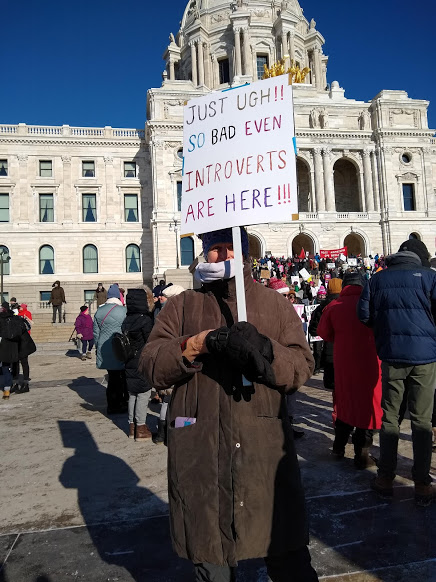
Among the marchers was a person (I think it was a woman but, really, once people are that bundled up, it can be hard to tell) carrying this sign: Just Ugh!! So Bad Even Introverts are Here!!

Yes! Introverts, women, teenagers, former colleagues, trans folks, children, old lefties like me, fresh feminists, church buddies, men and more. People who just had to roll out of bed on a frigid sunny Saturday to join 4,000 friends and allies in front of the Minnesota Capitol to cheer for women’s rights and human rights and justice and love. And to sing.

Perhaps: What’s-his-name could be seen as a strange gift for providing the push to get us out of our doors?

Like the GOP leaders in Minnesota who decided to put an amendment on the ballot to define marriage legally as involving a man and a woman. What were they thinking? “Enough of your funny stuff, you crazy liberals! We’ll cut you off at the pass.” Ah, but: They unwittingly provoked those liberals, plus the lovers of fellow human beings, the family members and friends of GLBT+ people, those who had been taught to love their neighbors, those simply living their lives who said other people should to be able to choose how to live, who to love, who to marry, if they wanted to. Just say no to hate. Love is love.

It wasn’t easy for me to have phone conversations with strangers, but it was oh-so-important. “You’re married, you love your wife. . . . You like your gay neighbor. What if he wanted to marry the person he loves?” “. . . oh . . . I see what you mean.” One conversation at a time; one voice speaking one’s truth to another.

The same day of the women’s march, activist John Pavlovitz came to Plymouth Congregational Church in Minneapolis. (From his blog: “It is offensive to me that millions of loving, compassionate, intelligent, kind, creative people walk away from faith because professed religious people like the Pences regularly expose them to the greatest violence.”)

He calls on all his million blog followers to live their best lives, to be their authentic selves, to nurture their compassion and kindness. John was terrific in person–funny and poignant and pointed. Like George Carlin at times, sans swearing. And he was very clear, during the Q & A, that following Jesus means more than reading scripture. We should live as Jesus would today, speaking out against injustice and having tough conversations about what’s hurtful to us in this societal landscape scorched by political rage and cultural friction. We need to take a stand against What’s-his-name and his lickspittles and sycophants.

Speak up. Sing out. BTW, it turns out “Sing, women” was a mondegreen*; the lyrics actually are “sing with me, sing for the years.” So let’s all sing: Dream on. Dream on. Dream until your dreams come true.

(*tip of the hat to Gene Rebeck)

Misfits on the Way

“This is just the beginning,” my sister Anne told me. “Oh?” “Yes.” A mystery shimmered on the phone line linking St. Paul with Ellensburg. Yet, I didn’t ask for the details; it was my baptismal day and the details of that evening’s service harried me.

How would the priest wet my head? What was this bit about the oil? In an English-Spanish Easter Vigil, would I be able to follow along? Was this the right thing to do? Wasn’t I making promises and commitments that seem daunting? Perhaps this path would lead somewhere conventional, uptight even?

Not by looking at my “godparents.” They were not wishy-washy, Minnesota nice nor reticent to speak their minds, whatever ripples might ensue.

Passionate about Jesus and committed to his church (he served as a lay leader several times), newspaper journalist Wayne said “G_ddamn” a lot . . . in the newsroom and in the church, it didn’t matter. Prone to cursing myself, I liked that he didn’t hold back. But later, when his newspaper friends and colleagues came to his High-Church Episcopal funeral and heard the eulogy, they were surprised at his deep faith.

That made me a little sad; I resolved, wherever I might be, not to disguise my belief in Christ. (But, please God, keep me from being stiff-necked and self-righteous. Ack! This way is not so easy.)

My “godmother” Leigh and I discovered we both shared a good measure of Chinese culture and language while car-pooling to the priest’s house for a pre-baptism dinner. Zenme ban!? It seemed like a God-nudge that  helped seal the direction I was traveling. Like Wayne, she could be seen as a character—even a misfit. Despite Harvard credentials, she was hobbled by childhood abuse. She pushed away family, ticked off supporters and yet invited me into a church hall—over a threshold that 10 years earlier I could not have imagined stepping.

It took a misfit to open the way for a misfit.

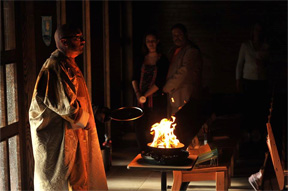
Wayne and Leigh stood behind me on that April night in 1999. Incense floated from the censers, the priest’s robes glowed in the candlelight and, as I dipped my head to receive the blessed water, the Spirit rushed in and filled me.Easter Vigil.St. Christopher's.sm

Just the beginning . . .

[Note: Photo shows Fr. John Dwyer and the Holy Fire at St. Christopher’s Church in Roseville.]


Happy Trails

Bushwhacking, side-stepping, slipping down the mountainside through brush punctuated by spindly tree trunks, breathing hard from fear of bears, of unnamed threats, of being left behind.

A half-hour earlier on the glacier, Dad had plunged in up to his armpits; he’d dropped through a veil of ice into a crevasse. Hollering, he waved away my brother and me. He slowly pulled himself out of the crack and onto the ice field.

Then everything accelerated; suddenly, we were in a hurry to dismount this treacherous glacier in the Canadian Rockies. We rapidly changed from hiking Up the tongue of glacier toward a summit to going Down: any which way, as long as it was down. Dad and Richard consulted the map (I was 11 and, until seeing Dad nearly drop into another dimension, just happy to be in the high country with him and my brother). Single-file, we shuffled an icy path to the glacier’s pulverized rim of rock; up and over, then down the slope we walked and slid, bushes and trees snatching us from freefall.

Surprised by a flat path groomed out of the mountain’s side, we slop-stopped to catch our breath and our bearings. We were seeking Dad’s station wagon—but this wasn’t the trail by which we had come up the mountain. Which way? Another look at the map and we headed south, judging by the sun’s rays. We never carried a compass. By twilight, we arrived at the trailhead parking lot, relieved at being lost no longer.

Similarly by guess—educated perhaps, but still a guess—and by golly, my father strode, fell and slipped through life, breaking a path less taken so as not to be mistaken for ordinary. Never ordinary; following his lead was difficult, often exciting and seldom comfortable. To emulate his independence, I often went walking in the woods alone, spotting jack-in-the-pulpits, admiring tall Douglas firs and, one day, startling a deer. “What’s that human doing following my path?” she might have wondered, had she language.

Language and rhetoric and bravado—that’s what I absorbed in the summertime when my brother, sister and I would stay with Dad, long divorced from our mother. Arguing about politics around the dinner table; dismissing students who could not follow his lectures about philosophy (I hope he threw chairs at them only once); braving 50 years and his bulging belly by riding a motorcycle in the back country. The accident on a gravel road smashed his hands so badly that at least one pinkie could no longer bend. No more Brahms on the parlor grand.

And almost always he exuded seething disdain for anything he found mainstream and low-brow—rock stars, farmers (ranchers were different, somehow), wealthy people, businesspeople, Christians. This last group was blinkered from reality, reactionary in their politics, complacent with the world and self-righteous in their judgments. (Some media today seem to hold this view, too, taking loud-mouths and hate-mongers as representative of all Christians rather than individuals—and perhaps on the fringe). Worse, they were stupid. As children will, I absorbed his views, becoming as narrow as his depiction of the despised bourgeois God-lovers.

Breaking out of this constricted perspective took decades of my own sliding through life. After meeting a man on our 1980 guided trip to the People’s Republic of China whom I thought was not smarter than I, I applied to an Ivy League college for my graduate degree. Surprisingly, I was accepted and began meeting other smart people from around the country caught up in the recruiting net. My Dad told me it would be a crucible (“a place or situation that forces people to change or make difficult decisions”; I looked it up). One undergrad studying Chinese struck me as particularly down to earth; turned out, he learned a lot from working with the hands on his family’s ranch—one of the largest in Texas. Oh, okay; some rich people are all right, I thought. And well-mannered, too.

A few years later, working for a business magazine, I again and again interviewed interesting and intelligent men and women. Ours was a positive publication and I am not deceived: business has as many scalawags as other arenas of life. Yet so many people’s kindness and thoughtfulness opened my eyes to those in business who were not hateful and gouging, as my father would have it.

Later, after my divorce from my first husband—who like my father was an academic who didn’t want to treat his depression for fear his creativity would be stifled—I tried other directions. One was easy to slide into: accepted, comfortable and, ultimately, dark, pursuing gaiety through wine and fantasies of escape through men or miracles of money showers. After a while, I began to recognize that this path was so dark I couldn’t see the bottom.

I happened upon another, happier trail. In search of a nature story for the newspaper, I called the leader of a bird-watching trip at Hawk Ridge in Duluth. “Are you a birder?” he asked, his tone a bit suspicious. After a pause, I said brightly: “I like birds!” Yes, I found, I really love the birds and also really like the bird watchers (well, most of them). I fell for their close observations, their camaraderie, their constant seeking and their ability to unselfconsciously throw back their heads to put their binocs up to their eyes and study the sky.

Something in their seeking reminded me of two friends, Democratic Socialists from San Francisco who each deeply believed in Christ and were left-wing activists. I was intrigued in my 20s but still kept my distance (Did I think Christianity was contagious? Hmm, maybe I was on to something there). Could this species exist in Minnesota? One was Roman Catholic, the other Episcopalian. I began perching once in a while in Catholic churches—yet in these houses of the Great Mother Church, women were shunted to one side. Was my father’s dumping on organized religion and skepticism about professed God-lovers correct? Still, an atmosphere of prayer called to me. I flitted around until a birdwatcher-believer pointed me to an Episcopal church only blocks from my St Paul apartment. “You’ll like the music,” he said.

The red doors were opened to the breeze that summer day I slipped in the back and heard something I liked even more: the words of a priest dressed in a drab brown monk’s habit who spoke of pursuing justice in Central America. Wonderful—in that I wondered: Is this really religion? We can talk about real-life problems? Wow. (Believe, I know that some Christians would say it is not religion. But there you go: So many paths to God, to the Divine to enlightenment, as my Congregationalist colleagues have taught me.)

That fall, soft-spoken Father Bob was replaced by a fiery orator who practically hollered at us to take care of the poor and, in the name of Jesus, to fight for what’s right (and against the Right, as some heard it). He reminded me of Dad, a bit, yet opened up for me a new world of Christian belief and love. By spring, that priest of fire—later, I heard that Bill wore a flame-emblazoned cloak when he rode a motorcycle to his riverside ordination—had been doused and deposed but, fortunately for me, only after he had prepared me for baptism. Monkish Father Bob returned to baptize me in a bilingual Spanish-English Easter Vigil. “I’m envious that you are being baptized as an adult,” he told me before the mass, because unlike him as an infant, I would be aware of the meaning of the sacrament. Yet such a long road to arrive at this service, to begin this transition from stumbling alone to walking together.

This essential togetherness was brought home to me recently by John Dwyer, our priest at St. Christopher’s in Roseville. “As Episcopalians, when asked what we believe—which happens quite frequently—we can answer: Come worship with us. Come read our prayer book. For we are what we pray: Our prayers are our faith, our theology, our beliefs. Worshipping in community, saying all these prayers together, shouts out the importance of living together, of being in community. It allows us to say: We are the body of Christ in the world. We are telling all who will listen that the life and ministry of Jesus we are modeling directs us how to live our own corporate and individual lives. . . . That veil between heaven and earth is made more transparent, when the Word that is God, Jesus, and the grace and truth of his flesh and blood are made central to all that we do and all that we are. It’s so very simple . . . and so very complicated.” (Dec. 27, 2015 sermon, available on the church website.)

To join any Christian community, I felt I needed to be baptized. Dad, as he put it, had just not gotten around to it with us three kids. (To be fair, neither did our mother.) Gloria, the only one among his four (or is it five?) other wives whom I consider my stepmother, presumably took care of this for her five children. Hearing of my baptism, my mother confessed she had grown up going to the Congregational church in New England; first I’d heard that. My sister, who become a believer in her teens, said it was just the start of the journey. Oh, really? Yes.

My father had no comment at first; after a while, nasty letters began. Seven or eight years later, during one of our rare phone conversations, I dared to tell him about the social justice group I was working with at church. “I am proud of you,” he said. Surprised, I may have said, “Thank you.” Hanging up as soon as possible, I cried, quietly.

I didn’t want him to sense my emotion. I was the “toughie” among his six girls, the one who never cried, even while feeling lost in the Canadian Rockies. On that day split by a fall, we hiked a long way until we found the station wagon. I crawled into the back to lay down. The story is that, as my father drove farther and farther from bear scat and steep slopes, I slept for 24 hours. Perhaps I dreamt of another path—one wider, with guides along the way.

I was surprised again at Dad’s funeral, when a retired Baptist preacher revealed that my father talked with him many times about God. Turns out, Dad had been attending the Roman Catholic church in Ellensburg and was most recently worshipping with the Methodists. Once you start to slide, you may be surprised where you arrive. A month or so after his death, my sister mailed me his rosary and his rustic wooden crèche figures: at the center is Jesus, wonderful counselor.

wooden creche

Coda: I find comfort but not complacency in this reflection from Bishop Steven Charleston.

“Walk the sacred way of your own heart, following where you believe you are led. Do not imagine that you are the first to pass this way, or that you have made the path for yourself. Have the humility to see the trail before you, even if the signs for it are few and far between. Remain true to where it takes you, even though it may be a steep climb. Do not fear that you will lose your direction, but be trusting in the holy guide that shows you where to turn. If you meet another walk together as long as you can, but if you walk alone then go in love for any who may follow. Stop to rest as often as you can and notice what is around you. Travel well, walk in peace.” From Arrows of Light: A Spiritual Diary, Red Moon Publications, 2015.

Gobsmacked. Astounded. Delighted.

Leonardo da Vinci’s name, three stories high on a stone building, somehow caught my eye as I hurried to the bus. Was it the gold lettering? The ready-for-liftoff dynamic V? Perhaps—at this intersection otherwise dominated by the daVinci archweightlifter-bulkiness of the Minneapolis Convention Center to the southeast and a downcast city parking lot to the north—a sotto voce call from above to seek joy, beauty, love.

Other great names topped twin windows: Christopher Wren, renowned for St. Paul’s Cathedral in London; Filippo Brunelleschi, architect of Florence’s must-see domed cathedral; and, Charles Follen McKim. Didn’t he design the original building for the Minneapolis Institute of Arts? (His firm did, I learned; he had already crossed over to that heavenly city.)

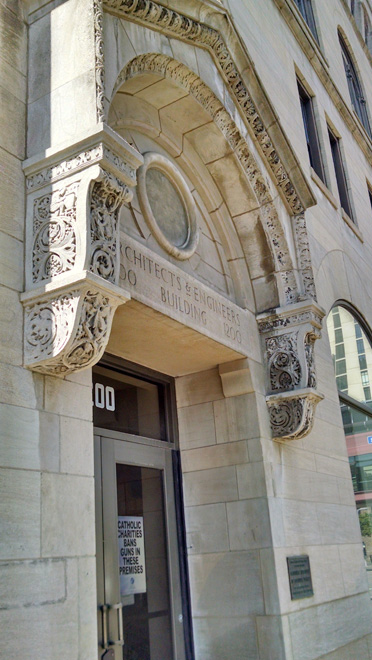
Later, on a more leisurely day, I walked another way by this now Catholic Charities office and came upon the original ornate entrance for this historic Architects & Engineers Building. Built in 1920 arch & engin.smin the Renaissance Revival style, it was a design incubator conceived by a group of influential designers dedicated to the City Beautiful movement.[1]

This treasure is just one among the buildings and details, windows and bas reliefs, that decorate our Twin Cities downtowns. I would have noticed none of them—except that I take the bus and walk, observe and appreciate the out-of-the ordinary, the individualized, the flourishes—touches that have been abandoned in favor of glass sheets held by metal frames. Skyscrapers mirror the sky; it’s no wonder the birds are confused and crash. An apparent exception, with strips of Kasota stone used in a “modernized art deco” style building, while lovelier than many, still seems sterile and impersonal to me.

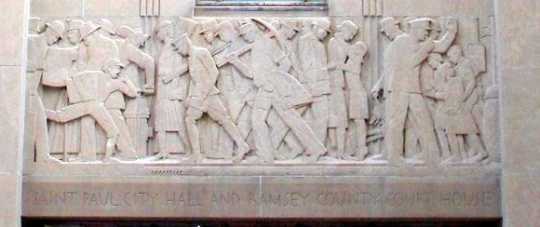
With my love for old ways of doing things, as in the Art Deco work, Lee Lawrie’s Voice of the People, Voice of the People Lee Lawrie

above a door at St. Paul’s City Hall, I recognize that I may be dismissed as nostalgic for a time in which I never lived. Yet, I moved by my dismay at the proliferating office building in the gray flannel suit, each one interchangeable with the next bland glossy construction, distinguished only by the signs proclaiming the occupying corporation.

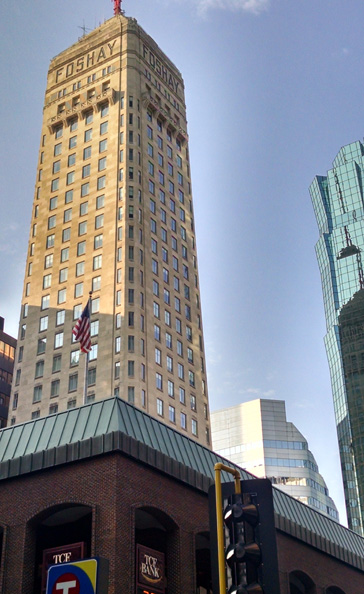
Foshay_TCF

Look at the Foshay Tower in the image; compared with the lumpy headquarters below and the aquarium in the sky on the right, it has character. Wilbur Foshay’s name is engraved on it: personalized, built to last and striking as the tallest building on the skyline until 1972. A company has made a hotel out of it but it’s still the Foshay.

Our built environment was briefly considered by Pope Francis in his amazing encyclical Laudato Si on climate change. “If architecture reflects the spirit of an age, our megastructures and drab apartment blocks express the spirit of globalized technology, where a constant flood of new products coexists with a tedious monotony,” the pope wrote. “Let us refuse to resign ourselves to this, and continue to wonder about the purpose and meaning of everything. Otherwise we would simply legitimate the present situation and need new forms of escapism to help us endure the emptiness.”[2]

A compelling and profound spirituality compared with my street-level observations. Godsmacked, you might say, to raise my sights higher.

[1] http://www.ci.minneapolis.mn.us/hpc/landmarks/hpc_landmarks_2nd_ave_s_1200-08_architects_engineers_building

[2] Section 113. http://w2.vatican.va/content/francesco/en/encyclicals/documents/papa-francesco_20150524_enciclica-laudato-si.html


We already knew ni ma “your mother.” Our Beijing tour guide just added the key word cao, because, he said, all Americans love to curse. Maybe the men had already learned it but I had not encountered this word until late in our weeks’ long study trip to the People’s Republic of China in 1980.

Last Sunday, The New York Times Magazine told us that on the Internet in China, 草泥马—“grass mud horse”—is a fool-the censors substitute for “a common insult that is unprintable in this magazine.” Gee, is that a common insult? I didn’t know. Maybe I’m hanging out with the wrong crowd.

Eavesdropping at 22, I filed this phrase in my mind as greedily as I did all the words, phrases, grammar—and experiences—I gathered during our brief sojourn in China. It had been only a year and six months since the United States had formally recognized the the government of the People’s Republic of China and, as a political science major in college, I was very eager to immerse myself into this long-forbidden country and delve into the workings of its socialist government.

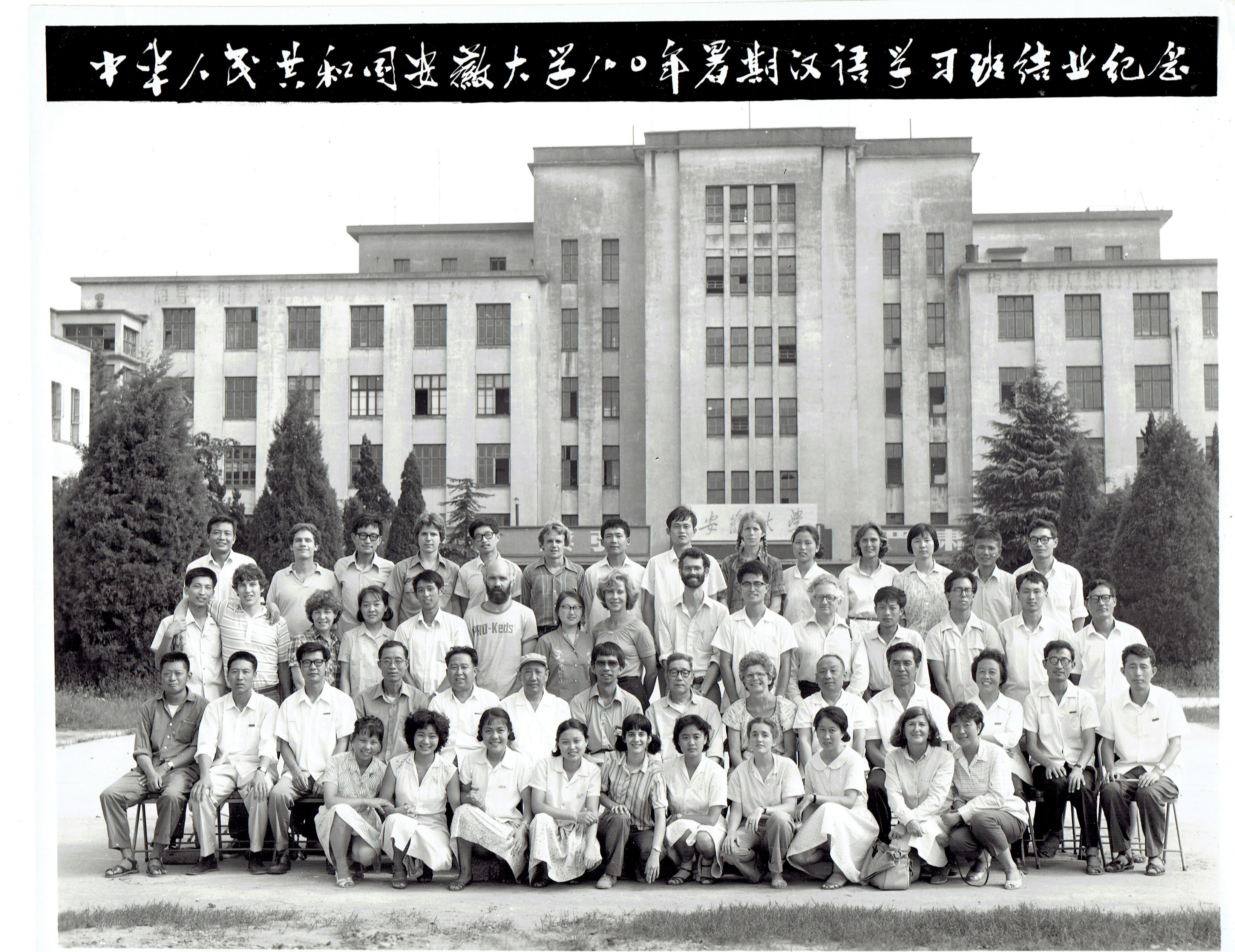
AnhuiUniversitySummer.1980

Our study group, comrades and teachers, Anhui Daxue, summer 1980.

Well, I learned some things. I saw bright aspects of life on the tea commune and in the fan factory that the trip leaders and party officials wanted us to see. And I also heard from Anhui University students shadowy stories of people being tortured during the Cultural Revolution and neighbors recording women’s monthlies to ensure they did not give birth to a second child and so violate the one-child policy.

Yet, most surprising to me among these New Men and New Women was a core of what I perceived as sweetness. About a week into our adventure studying in central China, my comrade, a female student about my height assigned to help me learn this tough language (and perhaps to keep an eye on me), asked: “Aren’t you homesick?” Surprised, I shook my head no. “But how do your mother and father feel about you being so far away? They must be crying!” Until then, I hadn’t thought about them perhaps missing me. So I asked her to take me to the post office, where I bought those lovely fold and seal Par Avion self-mailing letters and, in my tiniest scrawl, wrote to them about my days in China.

Thus I began to learn from a “heathen” Chinese a value that I would adopt as a commandment many years later, after I was baptized at age 40: Honor thy mother and father.

Speak Up

What did people think of the article about disabled people succeeding despite their handicaps? One editor praised the writer; another said he was pleased that Mpls.St.Paul magazine had taken on such a serious subject; and the designer pointed out how cool the images were. Visually, yes, these black and white photos taken from unusual angles were striking . . . yet I felt disturbed. I had to speak up.

“These photos are really powerful, but they make their subjects look weak,” I said. “Look at the guy in the wheelchair. He’s dominated by it; he even looks trapped. But if you know anyone who uses a wheelchair, it’s liberating. I have a friend with ALS. He’s not wheelchair-bound; his wheelchair gives him freedom.”

The room was silent for a moment. The designer fumed. I had been invited to the issue debriefing because editor Brian Anderson took seriously the business of grooming summer interns into potential magazine journalists. Perhaps I had scotched my future there, but so be it; I had to express what I saw.

Ah, Brian said, that’s a very interesting perspective. Thank you, Allison. And we all turned to the next piece in the most recent issue.

The designer quickly let her anger go. And, during what turned out to be our years working together at MSP Communications, I was able to give my opinion on visuals and page layout to her and other designers much earlier in the process. That didn’t mean that I was always correct or even swayed people—I was primarily a wordsmith, after all. But I continued to speak up and was heard as I worked my way up from intern to editorial assistant in charge of the events calendar and list-y stories (“Top 10 Ski Areas in the Midwest” and such) to managing editor at Twin Cities Business Monthly and later Mpls.St.Paul.

And during that time, years before Lean In Circles, I was fortunate enough to be a part of a group of uppity women editors from publications around the Cities. We gathered monthly to talk, to nosh, to drink wine and to plot our breakouts to the next level. Encouraged by each other and such colleagues as the late Brian Anderson, we spoke up and made our voices heard: important, whatever the risks.

Is this your new site? Log in to activate admin features and dismiss this message
Log In