Feeds:
Posts
Comments

God’s rainbow

“You’d be able to talk with media about youth issues—youth in church?” I asked, as I was getting to know the possible resources around my work place a couple of years ago. “Yes,” he said . . . “and trans issues, of course.” Looking down at the moment, I willed my head not to snap up: “Of course,” I said, continuing to scribble notes.

Except—of course—until then, I had not known he was a transgender person.

An All-About-Love take on Christianity was my introduction by a couple of gay guys in San Francisco nearly 30 years ago. Even after they planted that seed, it took many years to germinate. Yet, today, after more than 10 years of experience and study in the Christian faith, I remain mystified by those who believe they know that God or Jesus or St. Paul wants gay, lesbian, transgender people excluded from the full life of the church.

Once, in the basement of an affluent St. Paul parish, retired Lutheran Bishop Lowell Erdahl was talking about how he learned to open his heart and mind to gay and lesbian people. An older woman, wearing a vintage Chanel suit, responded: “That’s all wrong. Sex should only be for procreation.”

“Yeah, right,” I thought. “And clothing is only for warmth.”

As a stepmother and aunt and friend and fellow worshipper and colleague and fellow human being to God’s rainbow of gay, lesbian, trans and, yes, straight people, I would like the message of love to go global.

My co-worker, while retaining his staff role, has since gone on to be ordained in the Old Catholic Church of America. (Its primary overlap with the Roman Catholic Church may be respect for traditional style in worship.) Now, starting with a preview gathering July 23, he is planting The House of Transfiguration.

Would this new church be amazing news to the way-too-many people who believe that Christianity is anti-gay? I hope not—but somehow, they are not hearing about the inclusiveness of the United Church of Christ, my own Episcopal Church (almost all parishes anyway), and the Evangelical Lutheran Church in America.

I hope there are a lot more churches out there, too—congregations of many denominations that concern themselves primarily with loving their neighbors—all their neighbors. “You shall love the Lord your God with all your heart, and with all your soul, and with all your strength, and with all your mind; and your neighbor as yourself.” [Luke 10:27 NRSV]

Opnamedatum: 2012-10-29 1 t/m 7 in lijst sk-l-5460

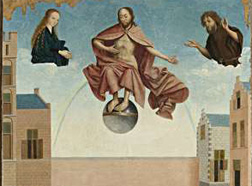
Image cropped from De zeven werken van barmhartigheid, Meester van Alkmaar, 1504, Rijksmuseum collection

God’s Houses

“What attracts you?” Laura asked, head cocked like a bird probing.

“The persistence and powerful pull of the idea of God . . .,” I said, for this dear friend was helping me to open a heavy door in my psyche. “I am amazed at the churches, chapels and temples people have built in which they worship God. They are beautiful—and they are seemingly everywhere.”

Visualizing a white stone building on distant green hills in Scotland, stepping into the eye-lifting, jaw-dropping space of Chartres Cathedral, and standing outside a shuttered beauty of shingle and fieldstone: the Virginia Street Church in St. Paul, designed by Cass Gilbert.

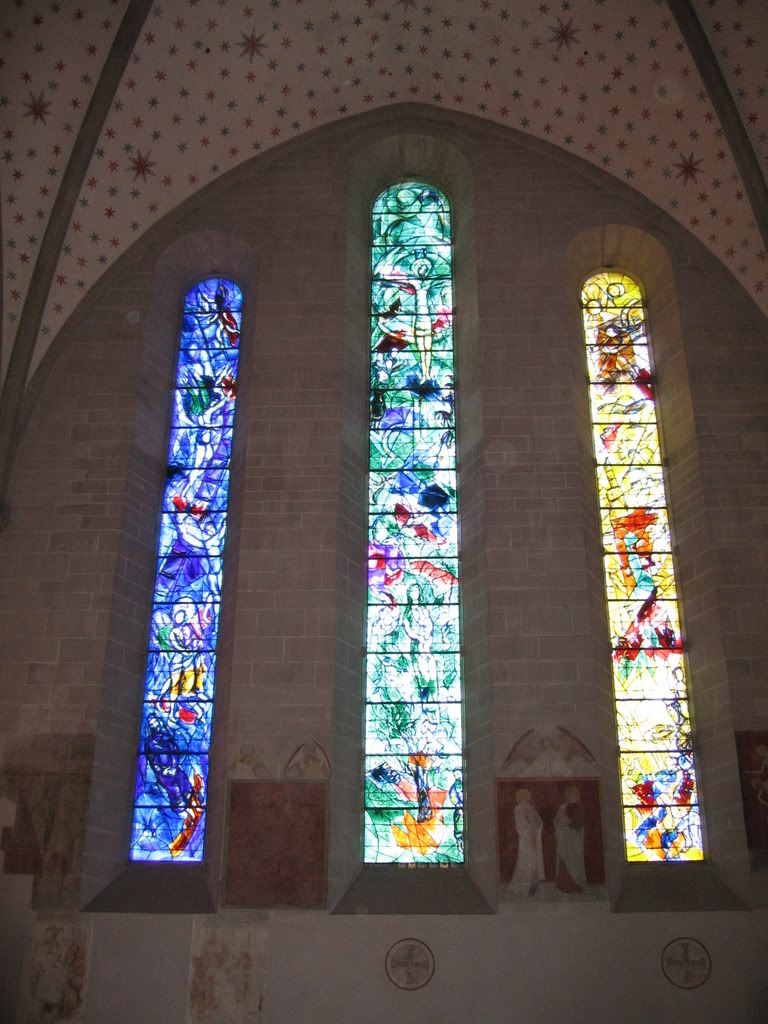
Another house of God that I entered long before I had an inkling that I would become a Christian is the Fraumünster in Zurich, a simple shell pierced by huge arrows of stained glass—bright, lithe and writhing images created by Marc Chagall. (See below) These houses of God were architectural gems, historical curiosities, museumlike collections of art.

At another shrine, Beethoven’s apartment in the Viennese suburb of Heiligenstadt, the matron said the great composer realized that he was going deaf when he could no longer hear the church bells ringing in that “Holy City.” For me, on the other hand, I never heard them ringing—until there was You. As in You, God. I began to recognize the holy characters, sacred scenes, lofty imagery in God’s many houses.

Yet God does not live only in the houses we build for God. The Celts have the thin place, where the veil lifts or even melts away between this world and the other. In Sedona, I explained thin places to Christine and, with a map indicating where to find the nearest vortex, she hiked high on the mountain and lay down to listen. She felt something special, intimate, a bit intoxicating.

And in all places—not magic but mystery, and very close: “Bidden or unbidden, God is present.”

chagall

Conversations

Gray clouds above promise more snow to white fields below. Spotting green through the windshield, I head for the grove of conifers. And stop. Sigh. Whatever was I doing on my own, tooling around the wintry countryside looking for birds?

Then, alighting on a deep-green branch: Brilliant red body, crested head with a orange beak poking out from black mask—the male cardinal, resplendent, suddenly appeared among deep-green branches. After a moment, he flew away.

“Thank you,” I said aloud.

Then I thought, “Who am I thanking? Who am I talking to?”

At the time, benighted by certain vague ideas of religion—to pray would be to plea for help from a distant bearded male God armed with lightning bolts (how I wish I were kidding)—I did not recognize this conversation as a prayer. Now I do.

There’s plenty to written about prayer, sometimes numbered, like Anne Lamott’s delightful Help Thanks Wow: The Three Essential Prayers, or categorized, as in The Book of Common Prayer that we Episcopalians use: “The principal kinds of prayer are adoration, praise, thanksgiving, penitence, oblation, intercession and petition.” Lofty language yet helpful, once translated from church talk: oblation, for example, means to offer oneself to the purposes of God.

But for me, sometimes, prayer simply consists of conversations. One-sided? Not entirely. During a prayer vigil on the Maundy Thursday before I was baptized, I experienced this scene: many cold braided streams rush by me, yet I stand on solid ground.

Naturally, that was in my mind’s eye; “the ear of the heart” is the extra -sensory perception that St. Benedict refers to in his compassionate Rule. To discern another realm—avian or divine—I turn up the attention dial. On my knees in the garden, I see a shadow of a large bird; pretty sure it’s a hawk, although I’d have to look to see which kind. In conversation with a friend, I hear a sentence that seems simple but an unseen shadow accompanies it—a God-nudge, perhaps, to ask a follow-up question.

Hearing the tree-top high pitches of Cedar Waxwings, my eyes follow my ears. Walking and talking on the phone, is that a poke? Although he hasn’t said a word, I look down at a man in his wheelchair. His machine is starting to slip in the slushy snow. I hang up and begin to push. As it turns out, a motorized wheelchair is heavy; more people come to help.

God involved a couple more in that conversation—and, every Sunday and often during the week, conversation—prayer—brings together my faith community. In my church, we together confess we have sinned “by what we have done and by what we have left undone….”—and that’s powerful corporate prayer, a preacher from another denomination told me. Yes—and the effect is like that of the small, square door called nijiriguchi, or “crawling-in entrance,” that guests must use to enter a traditional Japanese tea house: everyone, for a moment, is at the same humble level.

For me, seeking on my own is not the way; together is.

Northern_Cardinal Christmas

Belonging

Reading while bouncing along on the elliptical challenges me, so I was looking around at my fellow gymmies. One woman had a T-shirt decorated with a pea; and the word “Belong.” When she turned, I saw the other side, “like peas in a pod” with an image of tightly packed peas in a pod. Join a small group at this suburban church and you, too, could experience this tidiness, this uniformity, this comfort.

Comfort for her and others that I am certain would mean misery for me, however, given my unruly beginnings. Among the other anti-Establishment attitudes I absorbed, church was not valued in our family. Oh, we went to church, once. When I was about 7, Ma dropped off the three of us kids at a Presbyterian church and drove away. I do not remember the faces of the strange adults encountering an absent mother’s cast-offs—but do recall an aura of dismay or perhaps disapproval.

After that awkwardness, I was in no hurry to return to church.

In our house, the only phrases referring to God that did not also include –damn or -dammit were “God bless America and all the ships at sea” and “The Lord helps those who help themselves.” I took the latter to heart; relying on myself, I was able to use the Fannie Farmer cookbook to bake chocolate-chip cookies; to gad about creeks and woods solo; and, all on my own, clean out a former chicken coop for a playhouse. (Turns out that beforehand I should have asked the neighbor who owned the coop.)

Tops in my mother’s house—self-reliance; prominent wherever my dad was living when we’d visit in the summertime—simple orneriness. My parents divorced when I was 5, yet our parents agreed on that unspoken family value: It was admirable to stand alone and apart from the crowd.

Particularly in the early to mid-1960s when some crowds were saying hateful things about black people, outside seemed a good place to be. Yet even while our family embraced an idea of Brotherhood, in the real world, we kept to a very small circle. And we assumed those who wanted to belong to institutions—to the Elks, to a Big Business, to the Church—were not Thinkers as we were. To join something, after all, might erode that highly valued independence, might lead one to negotiate, to compromise, to cave—to lose an integrity of sorts. The sort that is never tested.

I scoffed at The Establishment, yet I yearned to step within an embrace. As I grew up, the good-hearted company of friends, boyfriends, fellow students, the family into which I married still left me wanting more. Divorced and headed toward my 40th birthday, I tiptoed into the Episcopal Church and experienced revelations of acceptance, of openness, of love. Jesus loved those who were apart—working folks, tax collectors, even ladies of ill repute. The calls to care for the poor resonated with the values I knew from my parents. Could I also retain their lessons about independence and still belong here in a church?

I could—even while I learned that regular partaking of Divine Love does not turn humans angelic. Churches may promise the Kingdom of Heaven, they just might have leaky roofs, shaky budgets or cranky people. About two years after I was baptized, my beautiful church to which people gave gifts—lace-trimmed linens for the altars, elegant banners for the walls, an image of abundance painted behind the altar—was in dire financial shape and digging deep into a bequest to pay the staff and keep going.

Word reached beyond the walls and the bishop came to chide us lay leaders for “eating the seed corn.” In a church that allows individuals the freedom of individual thinking, several loudly complained that the bishop had no right to tell us what to do with “our” money.

And there’s the rub. To my mind, it wasn’t “our” money; it’s God’s money. But people stubbornly chose to revisit the hurt every Sunday. Their anger and my frustration finally drove me out to search for a new faith community.

For the first six months, I strove just to be there—to be and to be lifted up in worship and not to be dragged into conflicts. Finally I stepped beyond, and suggested a social justice group that was approved by the lay leadership. After it was announced to the congregation, I was caught alone in the library by a very long-time member. “You aren’t going to cause trouble, are you?” she asked. “No more than Jesus did,” I said. She scurried away.

A couple of years later, she hugged me during the sharing of the peace and said: “Love you.”

Wow. Just like Jesus.

By living in this faith community, working through tensions (when possible), living with discomfort (when not), I continue to live into a new reality that Jesus loves me and so I belong here. And, dismaying as it may feel at times, Jesus loves everyone and they all belong here, too.

Recognizing that the tidy pod of peas cannot be my ideal—I was brought up a bit too ornery for that, yet I choose to belong to a community that shares my faith in Jesus, belief in God’s mercy and commitment to the Spirit.

My vision of that belonging looks more like a cottage garden, with splashes of peonies and upstanding irises, blue and white phlox, and pink roses scented with cinnamon. Standalone sunflowers (this is not a garden limited by seasons) towering over bunches of daisies, cheery hollyhocks and lilies in all their gorgeous variety…. Imagine! Which flower am I? Which flower are you? I pray and hope and believe our variety delights God.

To get along, I’ve found it helpful to have a few rules—yes, those Ten Commandments and the commandment to love God and to love others as oneself. To these I add the guidelines posted on Facebook by Bishop Steve Charleston.

“Live for love, work for peace, dance for joy, give for hope, think for fun, climb for strength, walk for a cure, share for freedom, look for meaning, save for tomorrow, spend for others, care for all, laugh for heaven, cry for a reason, help for community, stand for justice, journey for truth, fly for vision, feel for wisdom, hide for shelter, build for the homeless, dig for answers, pray for ever, plan for a purpose, speak for solidarity, read for knowledge, teach for fulfillment, learn for curiosity, imagine for God, compromise for humility, be for who you truly are.”

God loves us, as we are. God wants us to spread that Love around to everybody else, even those not in the circle, the church or any church.
Learning to speak

Maybe MSP Communications editor Brian Anderson had said enough farewells, as I had left the company twice already. This farewell luncheon was with another of the three men who ran MSP Communications: the sales guy, Gary Johnson. Usually I talked with Gary and the publisher, Burt, only at the meetings to discuss the latest cover of MPLS/ST.PAUL magazine.

Yet I anticipated that chatting with Gary over lunch would be enjoyable, as he’s warm, outgoing and, contrary to stereotype, sincere. Over dessert, we somehow meandered into what was for me new territory: I was looking at churches. Well, I admitted, maybe even popping into churches once in a while. (Left unsaid: to sit in the back and observe these strange creatures, the Church-goers.)

While I might have known Gary was a good Catholic—he’s a very open person—I still was surprised when he started talking about Jesus. Enthusiastically. Like Jesus was his good friend. Like Gary relied on Jesus—and he felt when he called on him, Jesus heard his prayers.

Wow, I thought to myself; this is wild. Gary is intelligent and worldly and successful—and he’s talking about Jesus. He was shaking my stereotype—that people who believe in Jesus or God moped outside the mainstream, were not savvy, maybe even not so smart. Perhaps I stuttered attempting a remark at some point; Gary said, “You don’t seem comfortable.” And so we moved on to a new topic.

But his eagerness to share his profound experience of Jesus stayed with me. And Gary’s ease and fluency in God-talk impressed me. This was a new language for me, much different than the two foreign languages, Mandarin Chinese and French, that I’d tackled only after reaching adulthood. God-talk ostensibly was in English; I started to absorb the specialized vocabulary—sin, prayer, liturgy, Holy Spirit, love—as if I were mastering an academic discipline.

I’d done that, after all, in my early 20s, when I studied Buddhism, read the great Chinese classic Dao De Jing and enjoyed Zen poetry. Each fed my mental eccentricity, however, without sparking any spiritual electricity.

On this new path toward a relationship with God, I could no longer rely solely on my thoughts, my head, my intellect; I needed to engage my feelings, my heart, my soul. Digging into feelings caused some anxiety; the thought of giving up things provoked much more. Unlike go-with-the-flow Daoism, Christianity, it seemed, would restrain my absolute freedom. Could I countenance that change, even while the prize of peace and caring as embodied by certain friends was pulling me forward? At first, I was wary.

Yet, visiting churches during worship services continued to call me. By listening to Bible passages, hearing the preachers’ messages and (sorry to anyone within earshot) warbling along with the hymns, I began to sense where this path might lead: a new way of belonging.

Dao, the Way, the first character of Dao De Jing, (also transliterated Tao Te Ching). Early Christians also referred to their new lives as the Way.
Annunciation

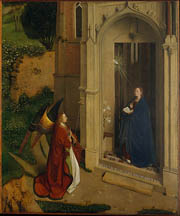
During my first-ever visit to the Metropolitan Museum of Art in New York City, housemate John and I stood in front of a late Medieval painting. The young woman was beautiful, dressed in blue and engaged in conversation with a person—albeit a person with wings. “The Annunciation,” I said, reading the title. “Sounds like an announcement.” I turned to John: “What is this painting about?”

“It’s the angel Gabriel telling Mary that she is pregnant with Jesus,” he said. “My grandfather, who grew up in the Tennessee hills and, although he was a preacher, could not read and write—he would have been able to tell you what the painting was about without even knowing the title.” Ah, but I had not been to church very often in my life, I told John.AnnunciationPetrusChristus.Met.sm

And, at the time, I certainly didn’t know stories from the Bible. What amazes me now about this meet-and-greet is that a winged creature suddenly appears and speaks and she does not flee; she trusts, she listens. Gabriel offers a friendship that will be fleeting but transforms her world—and ours. From chapels and cathedrals, to Crusades and conquerers—Christians have changed the world, albeit not always for the better.

Even raised with only a few tastes of Christianity, I could see the power of the Church and was both repelled and attracted. When my sister, who became a born-again Christian in her teens, invited me to come try her church and share fellowship with them, I wondered what this “fellowship” was.

Now, 15 years after my adult baptism, I understand “fellowship” as an offer of kindness, of acceptance, of friendship. People often use the term “church family” to refer to their faith community and it’s understood by many as having warm connotations—family means love and caring and supporting those who need it. But families, some families, have outcasts and conflicts and remote mothers and angry fathers…then “family” means a set of harsh relationships to which one has loyalty because you are supposed to, not because you are called to.

But friendship? That’s different. You choose your friends. And in my mid-30s, I slowly began to recognize that among my friends, most of those who truly exuded a reliable source of caring were already in a friendship with God—as Creator, Redeemer or Sustainer or, as the New Zealand Prayer Book says, “Eternal Spirit, Earth-maker, Pain-bearer, Life-giver.”

What they had, I wanted. And I began on a new path.

Now at night, you can’t miss St. Christopher’s. Spotlighted steeples, lit stained glass windows, lamplight pouring down on the church name in red–improvements made in the last year.

During the day, the church remains hidden in plain sight, modest and nearly noosed by the freeway cloverleaf. There is no outward sign of the inward improvements of new carpet and fresh paint that have refreshed the entries and hallways with patterns and color. Venture to the sanctuary and the baptismal bowl cradled in the aisle stands high, the better to admire its streaky blue, white and clear glass. The renovated altar area’s platformed broad steps, tiled the color of sandstone, evoke majesty and awe. Are we still in Roseville?

We are. And yet some in the parish feel they worship no longer in the Roseville church they have known. Just as this summer’s massive melting of Greenland’s ice pack signals to scientists a new phase in global climate change, the altar area’s replacement with a new look moves one group clean away from familiar patterns and they melt into anger. Now, storms can erupt more quickly as one influences the other. It’s unclear how long this interior climate change will last but it feels downright uncomfortable.

I pray that climate change of all kinds might be reversed–and for clearing skies inside our church.

Civil Society Soiree, St. Christopher’s Episcopal Church, April 15, 2012

In November, Minnesota voters will see the following on their ballots:

“Shall the Minnesota Constitution be amended to provide that only a union of one man and one woman shall be valid or recognized as a marriage in Minnesota?”

Voters may check Yes or No—or they may choose not to vote on it at all, which counts as a No vote.

Those who wrote this marriage amendment proposal used simple words to make a clear statement. Let me be clear with you from the start that I do not agree with that statement. But I am not here so that we might all agree—although that might be beautiful—I am here so that we might speak and listen and converse respectfully.

Let me begin by telling you a story. Our family includes Jeff and me—it’s a second marriage for both of us (we believe in marriage)—and his two sons, who are now my stepsons. I am blessed in them. The elder, also called Jeff, has always lived in town. The younger one, Nathan, moved away and lived for several years in Las Vegas.

A couple of years ago, Nathan’s Minnesota homing instinct kicked in. I don’t know about you but I know quite a few Minnesotans who spent some time away from the state and then come home.

Nathan decided that the roller-coaster adventure of living in Vegas was less important to him than the love and support of family and friends. And he brought his loved one with him, as many returning Minnesotans do. Torrance had visited us at Christmastime before, so let me assure you, he knew about the cold and snow.

So, in November 2010, Nathan and Torrance moved from Vegas and in with Jeff and me as they made a fresh start. They supported each other in their job searches; they did laundry; they went out with their friends; they took care of their dog, Bella. When schedules allowed, they ate dinner with us. They cleared the table and did the dishes. In that winter of big snows, they also shoveled our driveway numerous times.

Not much of a gay agenda, but there you are: ordinary Minnesota family life with much love, some money worries, and, most winters, snow removal. After five years together, they recently decided to get engaged to be married.

It’s beautiful. It’s also problematic because there already is a law in Minnesota that prohibits same-sex marriages. Now this so-called marriage amendment would enshrine this discrimination into the state constitution. And I don’t agree with that.

Love and commitment—for me, that’s what marriage is about. That’s what Nathan and Torrance and other couples want. And we Minnesotans—whether born here or having moved here—we believe in helping each other. We rely on our family and friends. We uphold fairness. And, if we don’t discriminate against people for who they are, we vote No in November on the so-called marriage amendment.

The group Minnesotans United for All Families came together last year to fight the amendment here in Minnesota. It has grown over the months and now includes more than 200 organizations, including faith communities. The website says: “We are a coalition founded on a strong belief in the power of marriage. We believe marriage and family are about love and commitment, working together, bettering the community, raising children, and growing old together. We believe in a Minnesota that values and supports strong families and creates a welcoming environment for all Minnesota families to thrive.”

Along with those you might expect to oppose this amendment—libertarians, independents and democrats—lifelong Republicans like Wheelock Whitney belong to this movement. He wrote an impassioned editorial that, among other things, spoke of the talents that gay and lesbian people bring to our local businesses.

And as it is for me, it is for him, it’s personal; he has gay family members. He wrote: “Far from defending families, this marriage amendment is an attack on my family. It is an attack on thousands of families across this state. I won’t sit by and just let it happen.”

Marriage matters. More than 20 states have had similar amendments that would ban same-sex marriage on the ballot. Minnesotans United tells us that, in other states, the research shows is that, even when voters knew gay people—they are friends, co-workers, family members—they did not had the meaningful conversations with them about what marriage means to them. We need to have those conversations. I suspect that we would find out, for many gay, lesbian, bi-sexual and transgender people, being able to marry would be a welcome change—even a reason to celebrate their love and commitment with family, friends and their faith community.

Have we not had those conversations because of stereotypes about gay, lesbian, bi-sexual and transgender people? We all make assumptions about people—it’s shorthand, it seems to make life easier.

But when it’s a matter of people’s rights to life, liberty and the pursuit of happiness, we need to have these conversations, even if they are difficult. We need to ask, “Is marriage important to you? Why? Isn’t having a civil union for gay people good enough?”

Finally, let me add my point of view as a Christian. I’m sure you are clear on this but let me say: I am not a theologian. In my readings and study of both the Hebrew scriptures and the New Testament, however, I have been bowled over by God’s great mercy and love. And I take to heart John 13:34, when Jesus gave us a new commandment: “that you love one another. Just as I have loved you, you also should love one another.” From what I understand, the “you” of Jesus encompasses the disciples, the tax collectors, prostitutes—those on the margins of society.

In Jesus’ time, “homosexual” was not a category or a term—but if it were and, if as in our modern society, it were used to make people into Others, Not Like Us, and otherwise excluded, I believe Jesus would have broken bread with people who happen to be gay, lesbian, bi-sexual or transgender.

They do not choose who they love. And we should not choose who to love; let us embrace all God’s people. Let us vote No in November.

Church family?

Church people—and I’ve been one for about 14 years now—often refer to “our church family.” While the cynical self that I was raised to be might raise an eyebrow at this catchphrase, my Christian side that now I feed finds it so very apt. Our parish, our church family, has conflicts: People feel distressed at changes, others believe they are not heard, decisions about money divide some and a few struggle to take the alpha position.

But our family ties? Not human blood but the blood of Christ connects us. Not physical birth but adoption into the family of God. Not loyalty to a family name but fealty to a greater Reality.

And that Alpha position? Alpha and Omega: Taken.

Those connections, that community, this family often are the terms I use to explain why I became I Christian after being raised without church, without God—even scoffing at God for a time. This commitment does not make life easier. Actually, following Christ calls me and us to serve the poor and to welcome the outcast, not to speak of loving one another (even those we don’t agree with or find annoying—see above). Yet that love carries me to the next unexpected step along a path that is unclear but bright. It’s all about Love: unfailing love.

Seconds: Another look

Scales, spots, slashes—slipping my knife under the apples’ skin, I remove the oddities, cosmetic surgeon to the Haralson seconds, half the price yet as the peels rise, the perfume is luscious. Then one comes to hand that seems perfect, deep red peel strips off to reveal white flesh. Why did it become a second? It’s a bit small, so runtiness perhaps doomed it.

So minor, this difference, to me and yet to someone grading the apples, enough. It can be mysterious which differences will determine who or what is valued and what or who is cast into the seconds bin. When we look at each other, could we see beyond the skin (sans knives)? Could we catch a whiff of the perfume of shared Spirit? Could we say: “no seconds”?

Is this your new site? Log in to activate admin features and dismiss this message
Log In