Feeds:
Posts
Comments

Posts Tagged ‘climate crisis’

Plastic-free fail

Of course, I would sign up to eschew single-use plastics! Who wouldn’t? Seems such a simple step to cut one’s carbon footprint (plastics being made from fossil fuels).

Except it wasn’t. Didn’t my favorite Eastern European Deli in Minneapolis formerly pull their sausages from piles under the counter, then wrap them in butcher paper? The heavy white paper could hardly contain the aroma of garlic and spices in Ukrainian and Polish sausages on the way home: Preview of deliciousness!

On Saturday morning, the Ukrainian sausage I bought looked luscious but was wrapped in plastic. Very hygienic, perhaps, but not nearly so delightful, without the scents of lunch to come and contributing to my nearly complete fail at going plastic-free.

Over and over, at the deli, the grocery, the Chinese take-out joint, I failed. The good part? My awareness of all this plastic was heightened to an alarming degree. Salad in a plastic box (reusable for harvesting in the Giving Garden, at least); guacamole, very organic and natural, in a plastic round (maybe reuseable but don’t put it in the dishwasher or your round will end up in a twist); and the plastic bag that the electronics store placed my new keyboard in. Anyone could tell I wasn’t shoplifting, but did I need that bag??

At least I’ve broken the flimsy plastic water bottle habit and now use a metal one for bicycle rides and other sipping situations. Not as conscientious as the generation now becoming adults, who carry water bottles that would carry them through the overheated Southwestern desert for a day!

And why not prepare for that, as we experience the warmest days on record, on Earth?

Tomorrow, I’ll start my plastic-free again! And keep my ratty yoga pad until it falls apart. Can you fashion one from cotton, you think?

Read Full Post »

This content is password-protected. To view it, please enter the password below.

Read Full Post »

While he was still Bob—not yet Dad—he loved the water, swimming in Lake Michigan. Later, as Dad, in the summer he might take a couple of his kids when he would meet his friends to float down the Yakima River in inner tubes. And, whenever the world got to him, if he wasn’t holed up in his study, he was soaking in hot water in a deep clawfoot tub.

Our Dad, known outside the home as Dr. W. Robert Goedecke, professor of philosophy, spun for us many tales, arising from sources like Yakima Nation lore to Claude Levi-Strauss’s analysis called Structuralism to Aristotle’s teachings to the thinking of Heraclitus. The latter, who lived in Ephesus 530-470 BCE, famously said you can’t step in the same river twice. (Well, that’s one interpretation of his line “We both step and do not step in the same rivers. We are and are not”: See Philosophy for Change for details.)

I liked that saying about the world constantly changing—and each of us changing as well so that moment to moment we are different. So, I embroidered for Dad a piece that declared: “You can’t float in the same river twice.” I was 13 and unschooled in handwork—the river was bright blue thread in a clumsy chain stitch, the lettering a bit shaky. But he liked it and tacked up the postcard-sized piece of muslin on his bathroom wall.

Now, his eight children live in a variety of places around this beautiful country—each near water. From eldest to youngest: Richard lives not far from Puget Sound; Anne, the Yakima River; Allie (me), the Mississippi River; Tracy, the Cowlitz River; Stephanie, Puget Sound; Trish, the Mississippi River; Bobby, the Willamette River; and Lori, the Connecticut River. Water unites us along with family ties.
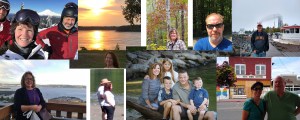
 

And so it is with the great human family: water unites us; living together on this beautiful, threatened planet unites us.

Yet, feeling united can be tough. A colleague told me that people evolved in small groups, up to maybe 50 people. In these ancient human groups, they all knew each other, trusted each other and, when someone broke the mores of the group, they all knew it. Now, he went on, we live and work and worship in, some cases, much larger groups—and, given our ancient precarious way of life, which lives on in our deep brain, we tend to be distrustful of those outside of our immediate family or affinity group.

Gee—that distrust is a huge barrier to overcome if we want to join together to turn our global, national and regional habits and practices toward a direction that will address and perhaps even (in the long term) reverse climate change. How can we change? After all, the news about climate change, the greenhouse effect, global warming, global weirding—none of this is new.

What seems to be changing is the focus: That this climate crisis is real and involves and affects all of us. We are beginning to wake up, whether because we are really listening when young climate activist Greta Thunberg schools the U.S. Congress to trust the science or we are barred from one of our most popular state parks in Minnesota by high water from March until now or we know people living through tropical storms threatening islands and coastal cities (Hurricanes Maria, Harvey, Dorian and the recent aptly named Depression Imelda—I’m talking about you. Why do we personify storms by giving them names, by the way?).

We are recognizing that our world is changing and we play a role in it. During the climate strike Sept. 20, an estimated 4 million took to streets around the world to demand change. That’s hugely important.

Also important: Each of us makes choices every day that move the future in one direction or another. Be intentional and consider these changes:

  • Drive less—combine trips, ride a bike, take a bus.
  • Find out if your retirement funds are invested in oil companies—and divest.
  • Buy enough but not too much food—don’t waste food or, if you have too much, compost it.
  • Check out Project Drawdown for 100 climate solutions, with the science explained.

And, like Dad, return to the water that we all share and revel in it. I didn’t live with Dad much as an older child but Tracy tells me that Dad “sometimes did the back and forth from very hot to very cold, from scalding bath to ice added to the kids wading pool on the patio, or out into the snow in the winter” in a manner related to American Indian sweat lodge practices, to gain clarity.

Body and soul and heart and mind—all are related as we seek to lead on climate. I’m in—how about you?

Read Full Post »
“Wastin’ away again in Margaritaville
Searchin’ for my long lost shaker of salt
Some people claim that there’s a woman to blame
But I know it’s nobody’s fault . . .

“Yes and some people claim that there’s a woman to blame
And I know it’s my own damn fault.”

A song so famous, it even has its own website. Yet, for years, I had not heard Jimmy Buffet’s epiphany—that he owns his self-medicating-with-margaritas mess.

We have a mess to own, too, and it has to do with Hurricane Dorian battering the Bahamas and heading for the Carolinas. Climate change means Dorian and other tropical storms, fueled by warming ocean waters, are becoming more intense and more frequent. Along with empathizing with the suffering, we need to think about our contribution to these disasters. “People are busy taking cover now, but ultimately we must act more broadly and more proactively for the long term,” former NASA science editor Laura Tenebaum wrote Sept. 1 in Forbes.

By we, I mean those of us who are financially comfortable enough to have choices. How about our transportation choices? My family can choose whether to drive or to fly for long trips. Although, as much as we love our cars, at times a person cannot drive—climate activist Greta Thunberg avoided the high carbon cost of flying and hitched a ride across the Atlantic Ocean on a stripped-down racing yacht. She and the team sailed from Plymouth, England, to New York City in 15 days.

That’s a lot of time! For a typical trip from Minnesota to visit my family and friends in the Pacific Northwest, arriving within a few hours or spending days on the road is the choice. Even the Empire Builder takes a couple of days—although, unlike in a car, passengers can walk around the train as they watch the beauty of the High Plains give way to the Rocky Mountains and the rolling fields of Eastern Washington carry them to the Cascade Range.

This morning, I choose to ride my bicycle to meet my friend Fran for a birding walk. We’re meeting not far from my home; it’s not raining; the temperature is about perfect—the choice is easy.

Some choices for the future of our planet, our island home, are easy. Turning off lights should be, although it seems that this easy step can be hard to remember, judging by the number of times I turn off lights I find on in unoccupied rooms. I’m not the only one: Harold at church, an older person with a good measure of wisdom, remarks about folks wasting money as he walks around flipping switches off in empty rooms. We don’t all have a Harold (or an Allison) following after us. Please consider this easy step to save energy, save money, save the planet: When you’re done, turn off the lights.

Many of the choices we can conceive, as we person up for the planet, are less easy. Consider cooling and heating our homes, our offices, our churches, our city buildings: there’s this feedback loop (“The air conditioning trap,” The Guardian, Aug. 29, 2019). “[W]armer temperatures lead to more air conditioning; more air conditioning leads to warmer temperatures. The problem posed by air conditioning resembles, in miniature, the problem we face in tackling the climate crisis. The solutions that we reach for most easily only bind us closer to the original problem.” Living in a cold (albeit warming) climate, I’m aware that we use a lot of carbon-heavy energy to heat our indoor spaces, too.

So, please, when you are the last person to leave the room, turn off the lights. And, while seeing the news about hurricanes, before pouring more margaritas, think about your everyday choices that could lead to a better future of the planet, even if they are a bit more challenging.

Read Full Post »

The House Wren’s staccato chatter–“my yard . . . my flowers . . . my bugs”–scolds me as I roll my bicycle from the garage. “My home,” I think to myself, even though I’m very glad to share with avian friends. It’s a sunny, glorious morning to bike to work, blue sky dotted with white clouds, a field of corn seemingly breathing as it grows on the St. Paul campus of the University of Minnesota, with only a light breeze to cool my sweat.

I’m pedaling hard so the nine miles go by fairly swiftly, past prairie grasses growing beside railroad tracks, the red sandstone Romanesque Pillsbury hall on the U of M’s Minneapolis campus and, of course, the powerful Mississippi River–still majestic even spanned by bridges and slowed by dams.

Starting the last mile, I ride up into downtown Minneapolis: autos, food trucks, buses. Oh, my! I’m not lollygagging but I’m not impatient as I wait for the light to change while sitting on my bike next to a yet another construction site at the intersection of Nicollet Avenue (buses and bicycles only) and 3rd Street. That turns out to be a good thing. The light turns green, I start to cross, and a black sedan whips in front of me, running the solidly red light! (license plate 81 032, state of Virginia, I think–I was a little verklempt).

While I had probably the cushion of several feet of pavement, so we were not in danger of an immediate collision, I am not armored. Oh, my beating heart! When she drove by me so fast, it came home to me how vulnerable I am on my bike in traffic. This leaving home is a risky business!

We all face another risky business, the climate crisis. We may be pedaling or driving or toodling along, not yet aware of how vulnerable we and our fellow creatures on this planet. On a glorious morning in Minnesota, one can feel complacent. We cannot perceive greenhouse gases rising at precipitous rates in that clear sky, which is a relatively thin envelope. Actually, we need atmospheric scientists to help us with those measurements–and they tell us we have hit historic high levels of greenhouse gases and the globe has experienced the five hottest years on record.

Yet there’s good news, too! I and eleven hundred of my new friends recently learned from Climate Reality Project founder and Vice President Al Gore that every hour the Earth gets as much energy from the sun as we need to run the entire global economy for a year. If we can increase the fraction of that solar power we harvest and use, we can make a lot of progress towards solving the climate crisis and helping local economies at the same time.

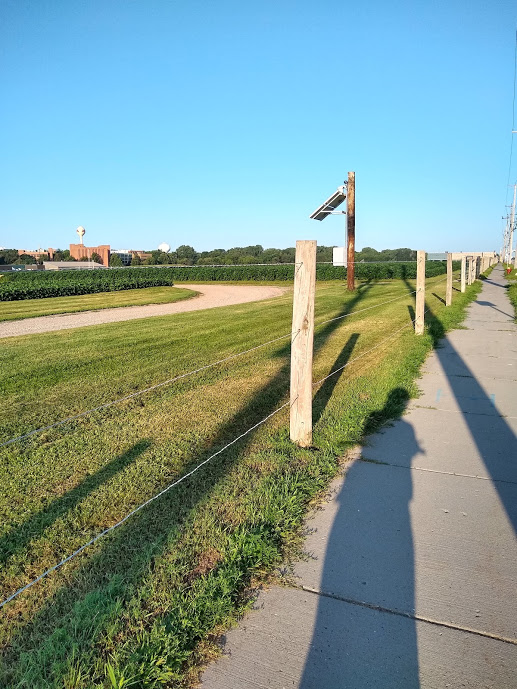
So thank you to everyone who installs solar, including my St. Christopher’s Episcopal Church (yay, Green Team!), the U of M–the photo shows a solar panel on the St. Paul campus (#UMNproud)–and my brother and his wife in Olympia, Washington. After all, we are not leaving this island home, our fragile Earth, anytime soon.

Read Full Post »

Is this your new site? Log in to activate admin features and dismiss this message
Log In