The House Wren’s staccato chatter–“my yard . . . my flowers . . . my bugs”–scolds me as I roll my bicycle from the garage. “My home,” I think to myself, even though I’m very glad to share with avian friends. It’s a sunny, glorious morning to bike to work, blue sky dotted with white clouds, a field of corn seemingly breathing as it grows on the St. Paul campus of the 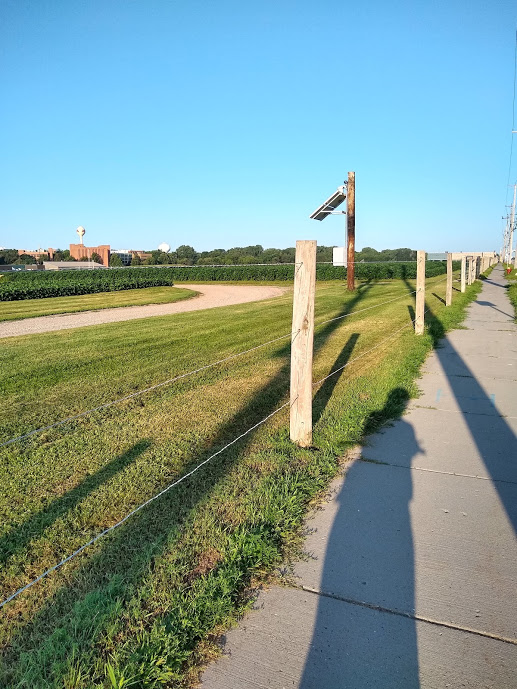 University of Minnesota, with only a light breeze to cool my sweat.
I’m pedaling hard so the nine miles go by fairly swiftly, past prairie grasses growing beside railroad tracks, the red sandstone Romanesque Pillsbury hall on the U of M’s Minneapolis campus and, of course, the powerful Mississippi River–still majestic even spanned by bridges and slowed by dams.
Starting the last mile, I ride up into downtown Minneapolis: autos, food trucks, buses. Oh, my! I’m not lollygagging but I’m not impatient as I wait for the light to change while sitting on my bike next to a yet another construction site at the intersection of Nicollet Avenue (buses and bicycles only) and 3rd Street. That turns out to be a good thing. The light turns green, I start to cross, and a black sedan whips in front of me, running the solidly red light! (license plate 81 032, state of Virginia, I think–I was a little verklempt).
While I had probably the cushion of several feet of pavement, so we were not in danger of an immediate collision, I am not armored. Oh, my beating heart! When she drove by me so fast, it came home to me how vulnerable I am on my bike in traffic. This leaving home is a risky business!
We all face another risky business, the climate crisis. We may be pedaling or driving or toodling along, not yet aware of how vulnerable we and our fellow creatures on this planet. On a glorious morning in Minnesota, one can feel complacent. We cannot perceive greenhouse gases rising at precipitous rates in that clear sky, which is a relatively thin envelope. Actually, we need atmospheric scientists to help us with those measurements–and they tell us we have hit historic high levels of greenhouse gases and the globe has experienced the five hottest years on record.
Yet there’s good news, too! I and eleven hundred of my new friends recently learned from Climate Reality Project founder and Vice President Al Gore that every hour the Earth gets as much energy from the sun as we need to run the entire global economy for a year. If we can increase the fraction of that solar power we harvest and use, we can make a lot of progress towards solving the climate crisis and helping local economies at the same time.
So thank you to everyone who installs solar, including my St. Christopher’s Episcopal Church (yay, Green Team!), the U of M–the photo shows a solar panel on the St. Paul campus (#UMNproud)–and my brother and his wife in Olympia, Washington. After all, we are not leaving this island home, our fragile Earth, anytime soon.
 Allison Campbell Jensen