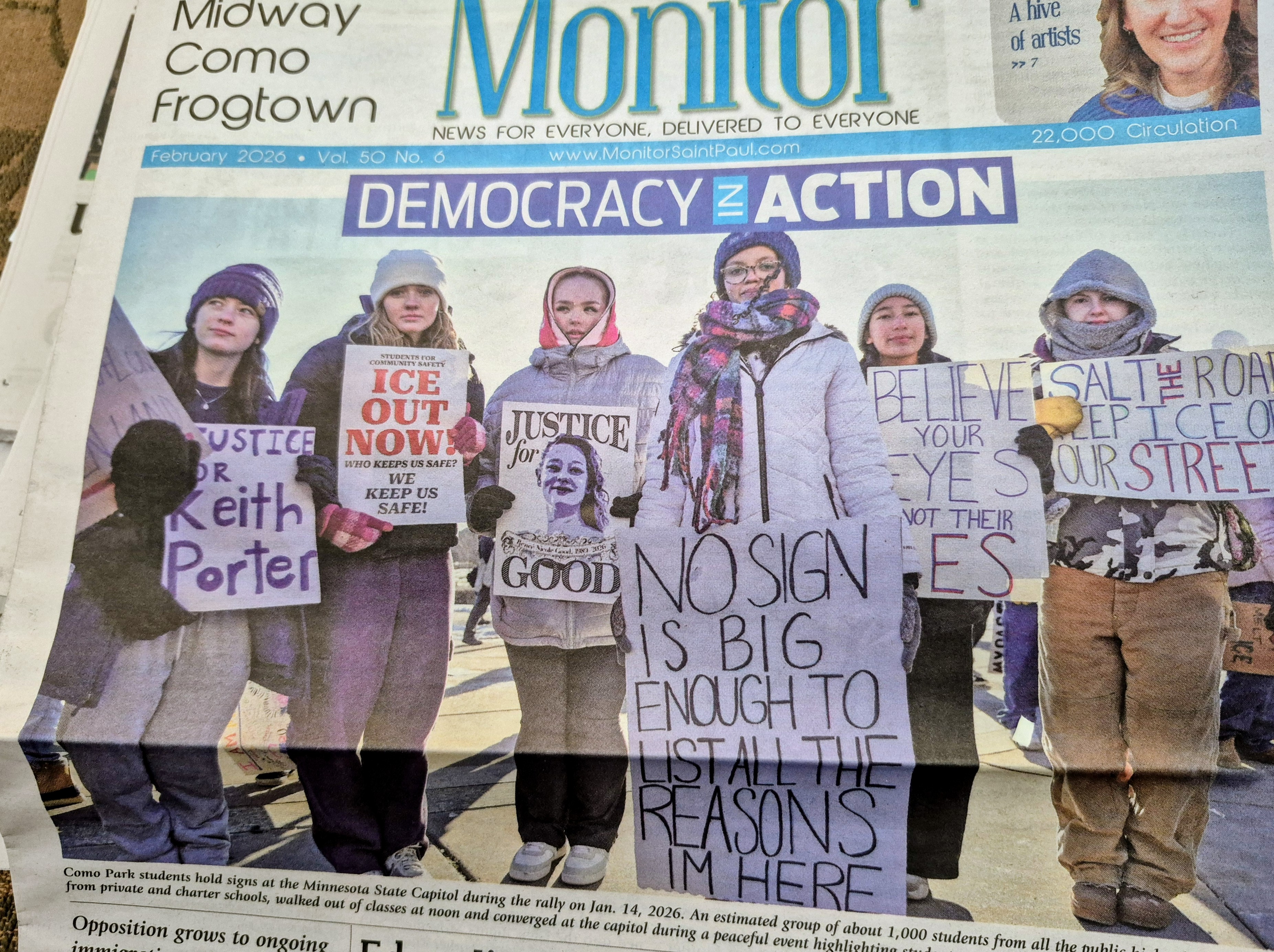
Schoolchildren learning about justice and the rights of free speech and assembly, in real time, for their friends and for themselves. Heroes!!
| Sylvia Lindman | ||
| Does it feel like this? Sent from my iPhone Begin forwarded message: From: JVL – The Bulwark <thebulwark+thetriad@substack.com> Date: February 21, 2026 at 5:43: | ||
| Allison Campbell Jensen | 10:29 AM (4 hours ago) | |
| Response to writing prompt from my dear friend. | ||

| Allison Campbell Jensen <allisoncampbelljensen@gmail.com> | 11:01 AM (3 hours ago) | ||
to Geneva, Jeffrey, Sylvia, me | |||
Background: I live in Roseville, Minn., founded about 75 years ago. It is located between the two downtowns of Minneapolis and St. Paul. I have lived here 25 years, with a garden and raspberries and, lately, cherry trees. I am white, retired, and in okay physical shape. I will be 68 years old in a couple of weeks. Although I go to the gym three times a week or so, my 11-year-old grandson can beat me in a 10-yard sprint–and he doesn’t even like to run!
When I first realized that ICE thugs were not confining themselves to South Minneapolis, I spent a week [considering, perseverating or musing] whether I had the physical courage to confront ICE. In mid-December, my neighbor, a lovely gardener and a lefty leader, asked if I would train to be an observer, like Pretti. Neither he nor Renee had been shot yet, but the thugs driving around town in vans and Jeeps and SUVs with faces covered, carrying firearms, including obvious long guns (rifles), had succeeded in scaring me.
I finally said I could not help with that part.
Then in January, we returned from a long weekend in Duluth, celebrating our friend Kim Eckert’s retirement, I noticed people in their 30s and 40s near the high school, wearing safety vests and looking around a lot.
At first, I feared there was an active ICE incident. Then I realized they were parents and neighbors protecting our children. One of my Resilient Roseville friends stood out for weekday mornings at the low-income mobile home park, to make sure the students made it to their school buses and schools without problems. One -20 morning, I drove by and, at the adjacent Central Park parking lot, there were the goons, faces covered, milling around their white vans with dark windows. Noelle was there, across the street, too, a sentinel and a possible helper: I admire her greatly. She also connected the threats of ICE and Climate Change and wrote about her experience.
I would wake up at 3 in the morning, or sometimes 3:33 and imagine what it might be like to confront ICE. I was fully imbued with great fear and would lie awake until time to get up to make coffee.
Marching in the NO KINGS rallies during 2025 felt much safer. We could see our allies easily and if a jerk in a pickup reared by with swearwords and middle fingers, I had recognized how many folks we had on our side, yelling back.
When 50,000+ Minnesotans protested against ICE in January, on the other hand, I feared they ICE agents would borrow helicopters from the Minnesota National Guard or shoot protestors with rooftop snipers. The fear, in other words, was deep inside me — and I was not yet ready to die for the cause. I wish I were kidding; I was paralyzed. But I watched and listened to the MARCHers (many of them friends, or like R.T. Rybak, former mayor of Minneapolis, well-known to me!) in the -25 cold, on an unedited video stream: Heroes.
In January, the Roseville City Council held two community listening sessions: searing, emotional testimony from a range of Roseville-ites, from people whose families had farmed in the area before WWI to folks who moved from other states within the last year. (After Felon47 ‘s second election)
The latter were Gay, trans, or with children trying to decide on their identity as people or sexual beings or simply families and folks seeking work, academic achievement, or community… They mistakenly thought Minnesota would be safe for them and their families. Sans Trump, I believe they would have been safe.
I listened to 4 of 6 hours of the first testimony–middle-aged women boxed in by ICE and harassed verbally. Young children, whose parents are professors at the U, who refused to go to school for a week or longer. A welder who has been welcoming immigrant newcomers for more than 2 decades–and tries to help them build shells against bullies. Because we do have bullies in Minnesota: white men, mostly, and some white women.
Once I was too emotionally wrung out, I left. My lefty leader’s spouse spoke about the “totalitarian oppression.” There were still about 200 people remaining to witness or speak. The second meeting, I stayed for only 2 hours. I left with my heart hurting and my head pounding: very anxious!!
The first time I went to volunteer at First Nations Kitchen in January, my friend Andy ran out shouting that a guy had been shot just blocks away.
Andy had the local video coverage playing on his phone. I entered the church and heard a man on the audio say: “BUT I DIDN’T DO ANYTHING!!” THEN, GUNSHOTS.
I am convinced that I heard Alex Pretti’s last words (or close). He had a deep voice. ICE gunmen silenced it.
Since then, I have given away $400 to orgs buying groceries for those too fearful of ICE to leave their homes and for rental assistance for those unable to work for a month or longer–because of fear.
At an Elementary school where I volunteer, I also saw the Anti-ICE, no entrance without a judicial warrant Signs go up on early January. Mid-month, after Mr. Pretti’s murder, the Saint Paul School District decided kids could go to virtual learning. I tutor 6 kids there 2x a week; and the abrupt disappearance of up to 1/3 the students (K-8) was shocking. Only one of my kids, a tall for his age Native boy, stayed away for a couple of days. Now, about a month later, About 1/2 of the students have returned.
Ms. K., kindergarten teacher, says her kids of color are still terrified.
Allison Campbell Jensen
Writer & editor
651-492-5931
| Allison Campbell Jensen <allisoncampbelljensen@gmail.com> | 11:04 AM (3 hours ago) | ||
| to Sylvia, me, Geneva, Jeffrey | |||
One more thing: we, Don and I were distributing EveryMeal sacks to kids. Don loves Ms. Kerrigan.
We chatted about the ways Felon47 and his crew of sycophants–and these blasted Brown Shirts–e trying to mold fearful children who are intellectually deprived, socially stunted, and have no trust in anyone. Easier to fool… Are simulacra of Hitler Youth next?
Let us follow our recent leader lost to Death: “Keep Hope Alive.” Thank you, Rev. Jackson.
Love,
Allison
Initial Answer to Syl’s writing prompt.
More TK but for now from FB post (not by me): “The floodwaters are finally starting to recede, but now we have to deal with the mud. For weeks, Minnesota has been submerged under a relentless wave of federal enforcement, and as the official tide rolls back, the structural damage to our neighborhoods is fully exposed. The cleanup is going to require everyone grabbing a shovel and working side by side.
Today is Saturday, February 21, 2026, here’s what happened yesterday in Minnesota:
ICE Shifting Outward: Despite the “drawdown” announcement, observers and elected officials say enforcement has expanded into the suburbs with smaller teams, more unmarked vehicles, and day-to-day presence in places like Eden Prairie and more southern suburbs. Friday’s Operation Metro Surge monitoring showed early-morning ICE activity also clustering around Shakopee and Burnsville, with reports of traffic stops and continued sightings in neighborhoods. Hospitality Union Unite Here Local 17 also says ICE agents are still being housed at multiple Minneapolis hotels, with observers tracking persistent vehicle staging in hotel lots… a sign the operation’s footprint remains active even as tactics get quieter.
Lawmakers Force Visibility: Federal officials told Reps. Ilhan Omar and Angie Craig that fewer than 500 ICE agents remain in Minnesota and that activity has “slowed” to about 20 arrests a day and two deportation flights a week, with a stated goal of returning to a “regular footprint” around 150. But the figures came with no public breakdown of which units are leaving or staying, unclear accounting for Homeland Security Investigations, and no transparency on how tactics are shifting. Then, during a scheduled oversight tour of the Bishop Henry Whipple Federal Building, staff said the detention area had been cleared about 30 minutes before the lawmakers arrived, blocking them from speaking with anyone in custody. Omar and Craig said they’re taking DHS claims “with a grain of salt” because the timing looked less like openness and more like control of what the public is allowed to see.
Courthouse Deal Fell Apart: The Star Tribune reported that Chief Justice Natalie Hudson quietly met with border czar Tom Homan and came away thinking there would be clearer limits and better communication about ICE activity in state courthouses. Four days later, ICE agents carried out a chaotic detainment inside the Hennepin County Government Center anyway. Lawyers and observers swarmed as people moved through the skyway at lunchtime. It read like a warning that even high level assurances can vanish at the moment they matter most.
Local Cooperation Disputed: Hennepin County is now openly accusing the federal government of rewriting what’s happening inside its own jail system. In a blunt court filing tied to the sanctuary-policies lawsuit, county attorneys dispute federal claims that local cooperation with ICE has increased, arguing the government’s story about jail holds doesn’t match the facts. Sheriff Dawanna Witt has also said no policies changed and no new agreements were signed, but the county is being forced to fight that narrative in court anyway. It’s a warning sign that if the “official record” gets set by federal assertions instead of local documentation, the outcome may follow the fiction, not the reality.
Even in the thick mud, people are planting seeds. Here are some reasons to hope:
Tonight Brandi Carlile Shows Up: The Star Tribune confirmed that tonight’s sold-out Brandi Carlile concert at Target Center will include more than $25,000 in proceeds going directly to The Advocates for Human Rights, the Minnesota nonprofit that has been on the front lines of the surge since December. The full show will be livestreamed free on 89.3 The Current. Carlile said she couldn’t come to Minneapolis without acknowledging what this community has been through and called Minnesota her family. Twelve thousand people in one room tonight, and anyone with a radio can be there too. Watch it here: https://veeps.com/brandicarlile/10bee30f-604a-40a8-9c39-6a0a6553d878
Judge Hears ACLU: More than 80 Minnesotans have now filed sworn declarations in the amended complaint in Tincher v. Noem, turning scattered allegations into a formal, testable court record of retaliation, surveillance, and alleged violence against people who tried to watch, document, or protest federal enforcement. After an evidentiary hearing, the presiding judge, Eric Tostrud (a Trump appointee), indicated he’ll rule on an expedited basis… he’s heard the testimony and he’s still deciding. That matters because once these accounts are locked into the record, they’re harder to dismiss, harder to erase, and more likely to produce enforceable limits.
The Courts Doing What’s Right: During Operation Metro Surge, lawyers filed 1,000+ individual challenges to detentions, and Minnesota federal judges have ordered releases hundreds of times after finding arrests and detentions unlawful. That local wave fits a bigger national pattern… 400+ federal judges across the country have issued 4,000+ rulings finding ICE held people illegally, as habeas filings surge amid record detention levels. The hope is simple and stubborn: case by case, order by order, the rule of law is still working because people refuse to disappear quietly.
Community keeps pressure on with new rally: 50501 is planning yet another anti‑ICE rally and march, set for today at Whittier Park in Minneapolis. Organizers are using it to demand passage of the accountability bills and real recovery funds for neighborhoods hit hardest by raids. After weeks of watching agents shift from city cores to suburbs, they’re making sure public attention shifts too. That persistence, showing up after the headlines seem to cool down, is how movements outlast operations. To find out more about the rally or how to attend, go here:
https://www.facebook.com/share/p/16sitMLQr9/
Looking past the state borders, here are some national stories worth knowing:
Tariff Takedown: The U.S. Supreme Court struck down Trump’s sweeping global tariffs in a 6–3 decision, ruling he lacked authority under the emergency-powers law he invoked, a major setback with huge economic stakes and looming questions about what happens to the money already collected. Within hours, the White House pivoted and issued a new order imposing a temporary 10% import duty on foreign goods under a different trade statute, signaling the trade fight will continue even after the court drew a line. The whiplash, court limits, and immediate workaround all sent a clear message to markets and governments: the rules are being contested in real time, and policy can change overnight.
DHS Admits the “Worst of the Worst” List Had Errors: MPR News confirmed this week that the DHS website used to publicly justify Operation Metro Surge, which listed people the administration called “dangerous criminals,” was riddled with factual errors. Some people listed as serious threats were legal residents, asylum seekers, or had no criminal records. DHS has quietly updated some entries without announcement or apology. The list was the public face of the surge. Its accuracy was never verified before it was used to justify detaining thousands of Minnesotans.
Let the Record Show
Nobel Winner Elie Wiesel warned us: “Silence encourages the tormentor, never the tormented.” That’s what this community has been fighting since December — refusing to let people be reduced to a label, a status, a checkbox on a warrant, and refusing to let the most powerful people’s version of events become the only version. That’s what’s at stake in Hennepin County’s pushback, lawmakers calling out conditions, communities tracking movement, and in Tincher v. Noem. Those 80 people who filed sworn declarations in federal court this week didn’t do it because it was easy. They did it because they understood what happens when nobody speaks plainly into the record: the harm keeps moving, and the story gets rewritten around it.
Every time DHS is forced to backtrack, the world sees the difference between narrative and evidence. The surge may be ending, but the record of it is still being written. Let’s make sure the truth is in it.
Follow me on Facebook: facebook.com/ldz451
Follow me on Threads: threads.com/ldz451″
Allison Campbell Jensen
Writer & editor




 Allison Campbell Jensen