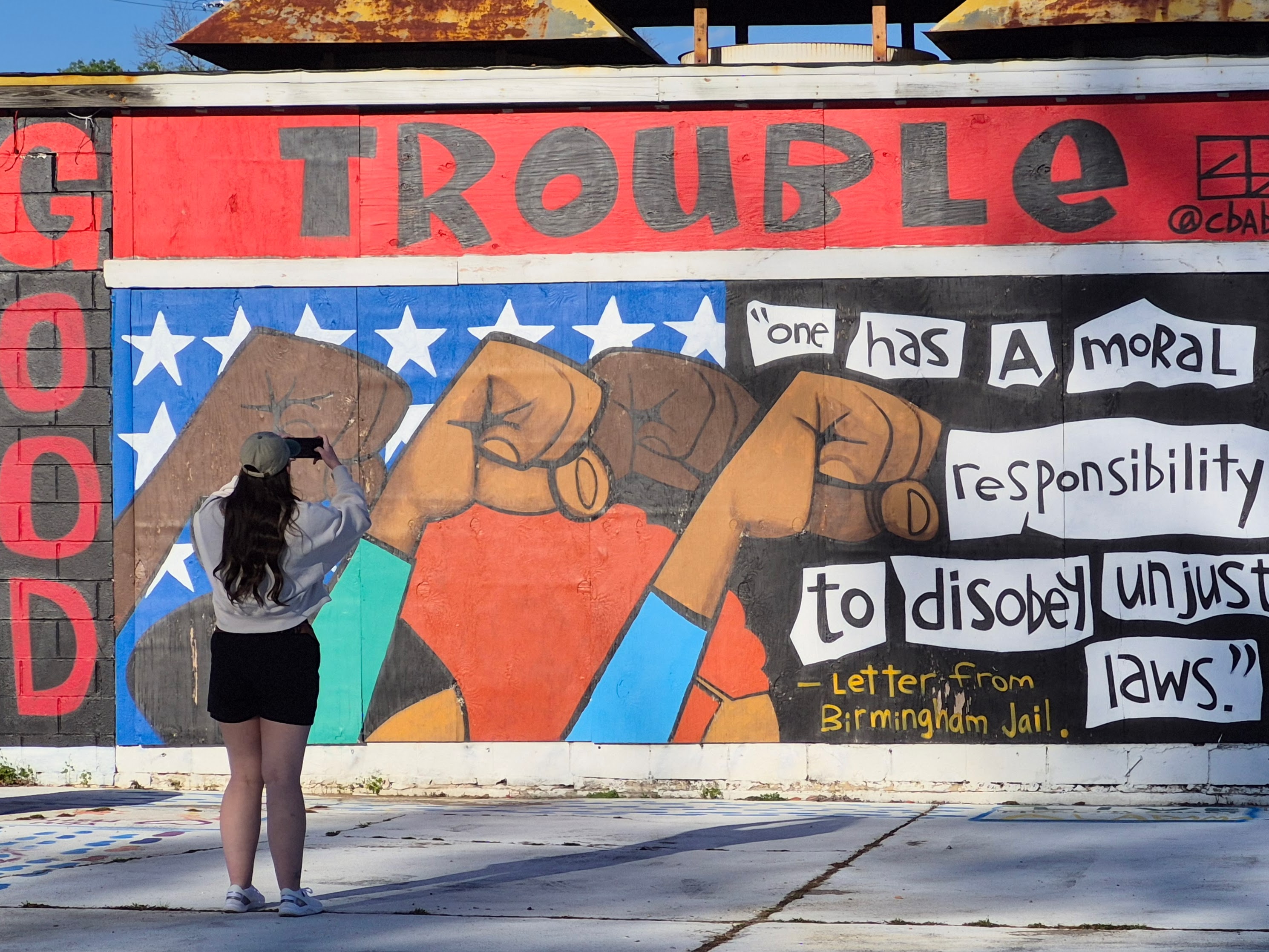
Among the multiple exhibits of brutality, startling statistics of violence, vivid videos, re-creations of the slave trade scenes, sweat-inducing tales, and photographs of the hundreds of people who fought for African-Americans’ freedom, Montgomery’s Legacy Museum also displays simple glass jars.
Huge jars, bigger than a person’s head, that hold dirt, loam, sand, clay, in colors as different as individuals are different. Ranks of preserves, shelves reaching nearly to the ceiling, marked with dates, with places, and, in larger type, with names—or Unknown.
Preserves of soil taken from more than 800 lynching sites where white murderers spilled African-American blood. At its nearby sibling National Memorial for Peace and Justice, people are silenced by the lists of Black people’s names, and, occasionally, 8 or 11 or 15 Unknowns, all killed on one date. Those memorialized on steel rectangles number some 4,400 lynchings, divided by counties.
The Deep South ruled by Jim Crow codes and the James Crow that spread to the North join in shame. In Duluth, Minnesota, three men working with a traveling circus were lynched in July 1920, for allegedly raping a white woman. Black people fled Duluth and nearby Superior, Wisconsin.
Breaking the silence for the whole country was one lynching—an extra-judicial murder carried out by white mobs for crimes as they defined them—of Emmett Till.
In 1955, Emmett Till visited family in Mississippi on what ended up to be a fatal trip from his home in Chicago. Mayor Johnny B. Thomas, who now leads the tiny, predominantly Black town of Glendora, recalls the details of the death of the 14-year-old “child.”
In 2025, the mayor led our We March for Justice Civil Rights Study Trip group of 19 people, ages 18 to 85, along Emmett Till’s Trail of Terror. Ours was the 14th Civil Rights Study Trip organized by faculty of the University of St. Thomas in partnership with the Selim Center for Lifelong Learning: David “Todd” Lawrence, American Culture and Difference, English; David Williard, American Culture and Difference, History; adjunct faculty Shanea Turner-Smith; and Selim’s Bob Shoemake. The trip leaders have visited for several years; they retreated into the background as Mayor Thomas directed our bus driver to crisscross the springing-green countryside of rivers, bayous, small shacks, tidy homes, and ruins—of the church where Till’s grand-uncle preached and the country market where he may have whistled at a white woman, now reduced to vine-covered walls,
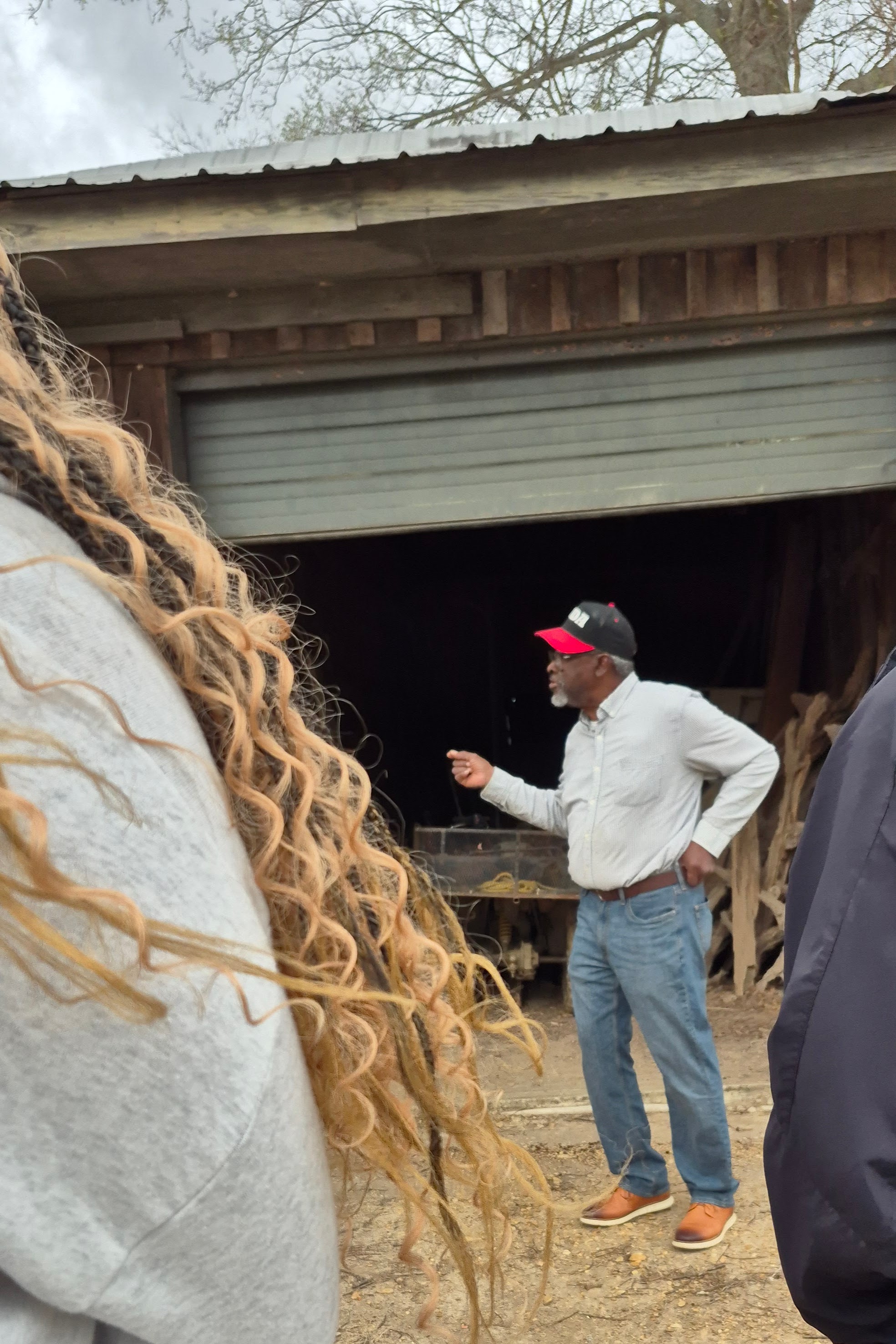
We heard details known in this locale but foreign to us. The white assailants forced Mayor Thomas’s father, and other Black men, take part in Emmett Till’s beating and murder.
Emmett Till was kidnapped from his great-uncle’s home, tortured in one white fellow’s barn, then paraded through the countryside like a trophy to other white households. Whether he was alive or dead at that point? Hard to say. His mutilated body was thrown off a bridge; it was found downstream by a young white man fishing.
Some catch.
Placing myself as a witness to this horror, I could not comprehend the dominant white men’s stance: that they were protecting something, a culture precious to them with a brutality poisonous to millions of others. That dehumanizing their Black victims as “beasts” also co-created white supremacists as predators.
Local white people buried Till right away. Yet, he would not be silenced in death because of his mother, Mamie Till. She insisted his corpse be exhumed and taken back to Chicago. Emmett Till’s nearly unrecognizable face was shown in an open casket—a horrifying sight that Jet magazine published. There could be no cover-up. There would be no justice, either. Although the white killers were identified by a Black witness, they were acquitted by an all-white jury. That witness left town to save his own life.
Mayor Thomas commemorates Till, his murder, and the Black freedom movement in his Emmett Till Historic Intrepid Center, housed in a former cotton mill in Glendora. He says he worries: he does not know who after him will carry on the work of deeply local remembrance.
Surviving
Cloaked in a shimmery tunic, Flonzie Brown Wright stood before us, a renowned Civil Rights leader and our guide to the African-American struggle with freedom in her community of Canton, Mississippi. She had grown up in relative privilege for a Black person in Canton: she attended Catholic school, and her mother would not allow her to do manual labor, because she expected better things of her.
Her mother having set the seed, and the soil being prepared with a surfeit of Black blood, already as a teenager, Wright began to push the boundaries of Jim Crow. From the time Wright saw white police beating a Black resident trying to register to vote (the photo is in her book “Looking Back to Move Ahead”), she was caught up in the civil rights movement. “I had to do my part for freedom,” she writes (“Looking Back,” p. 56). Having failed the test to register to vote one time, she practically memorized the U.S. Constitution—and the second time, passed.
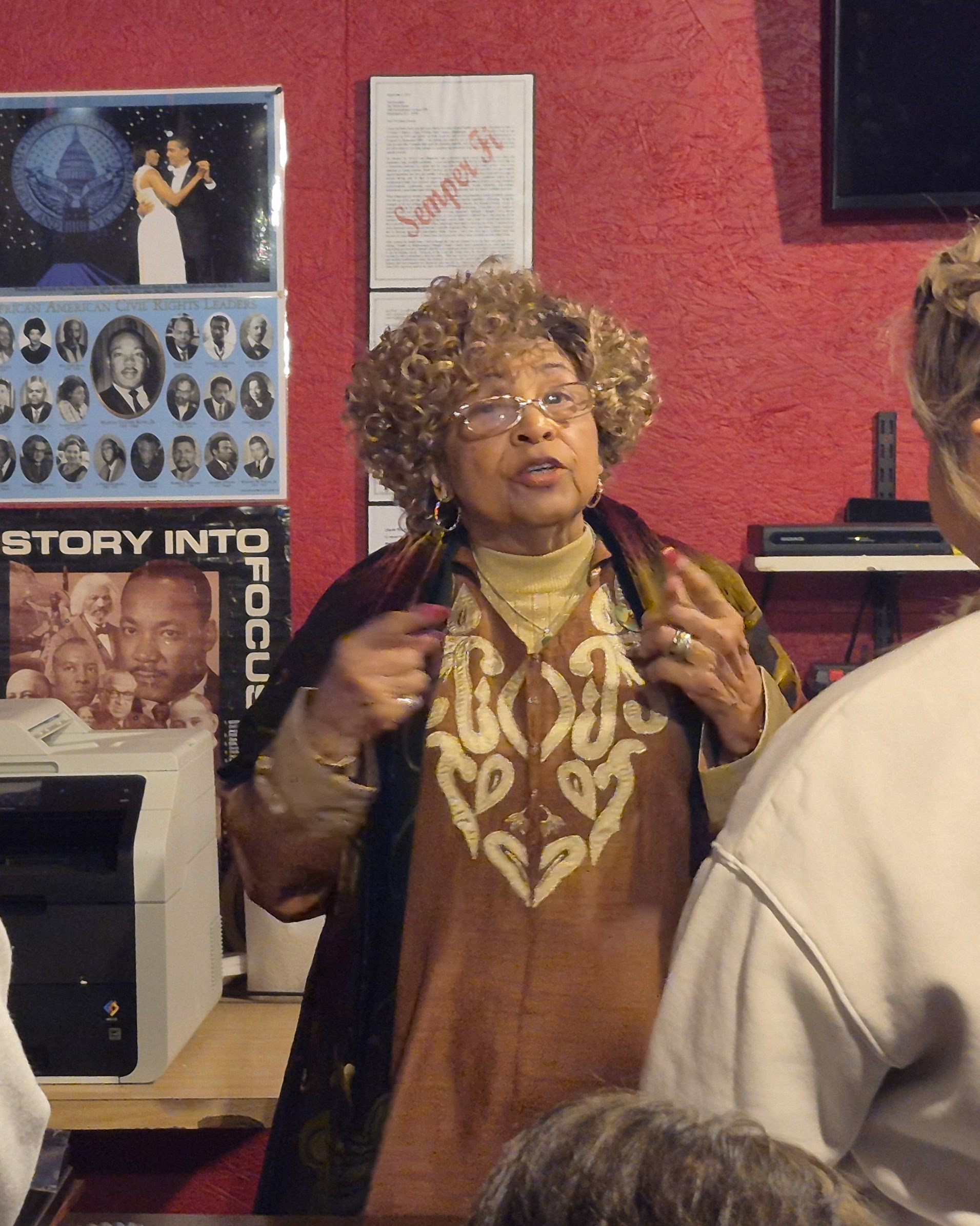
Wright not only voted, she went on to sue for Black rights to serve on juries; to run for Election Commissioner in Madison county in 1968 and win (the first African-American female in the state to serve in that role following Reconstruction); and to work at the Freedom House, the last one standing in Mississippi, a place to gather, to rest, to strategize for Black and white activists who belonged to any Civil Rights movement organization: NAACP, CORE, SLCC, and SNCC. In 2025, she showed us that the Freedom House still stands, wallpapered with leaflets and newspapers and election notices to honor those who fought for freedom.
Wright, who was being videotaped by a documentary team on the day we met her, commented: “Don’t things change?. . . In time, they do change.” Yet only when people who come together behind one goal. Asked about a speaker at one of their rallies, the “radical” Stokley Carmichael (the coiner of “Black Power” who later took the name Kwame Ture), Wright said: ”We needed everybody’s opinion . . . as long as our goal was the same”: Freedom.
Goosebumps
The profoundly personal accounts and somber depictions of those striving for a better society, from the thousands who took part in the Montgomery bus boycott, which lasted more than a year, to a speech/qua sermon by Rep. Justin Pearson of the Tennessee state house, are enough to shake sensitive, empathic persons such as myself.
Hearing the trail of Emmett Till’s terror retold on a warm evening in Memphis, a present-day activist declared: “Oh—I have goosebumps.”
Similarly, in Montgomery, we viewed the intact and active 16th Street Baptist Church. Asked about its possible renovation after four young girls were bombed to death in 1963 by white criminals, one lead faculty led me around to the back. On that hot day, I also suddenly had goosebumps. Already moved by the church’s floral tribute to these victims of racial violence, my soul was haunted by the extensive preserved blast marks.
Goosebumps provoked by the proximity to violence, to water cannons, to police dogs, to KKK bombs, to the assassins of Medgar Evers and far too many others were just a physical manifestation of the emotional burden I recognized and took on, to a degree.
The continuing movement
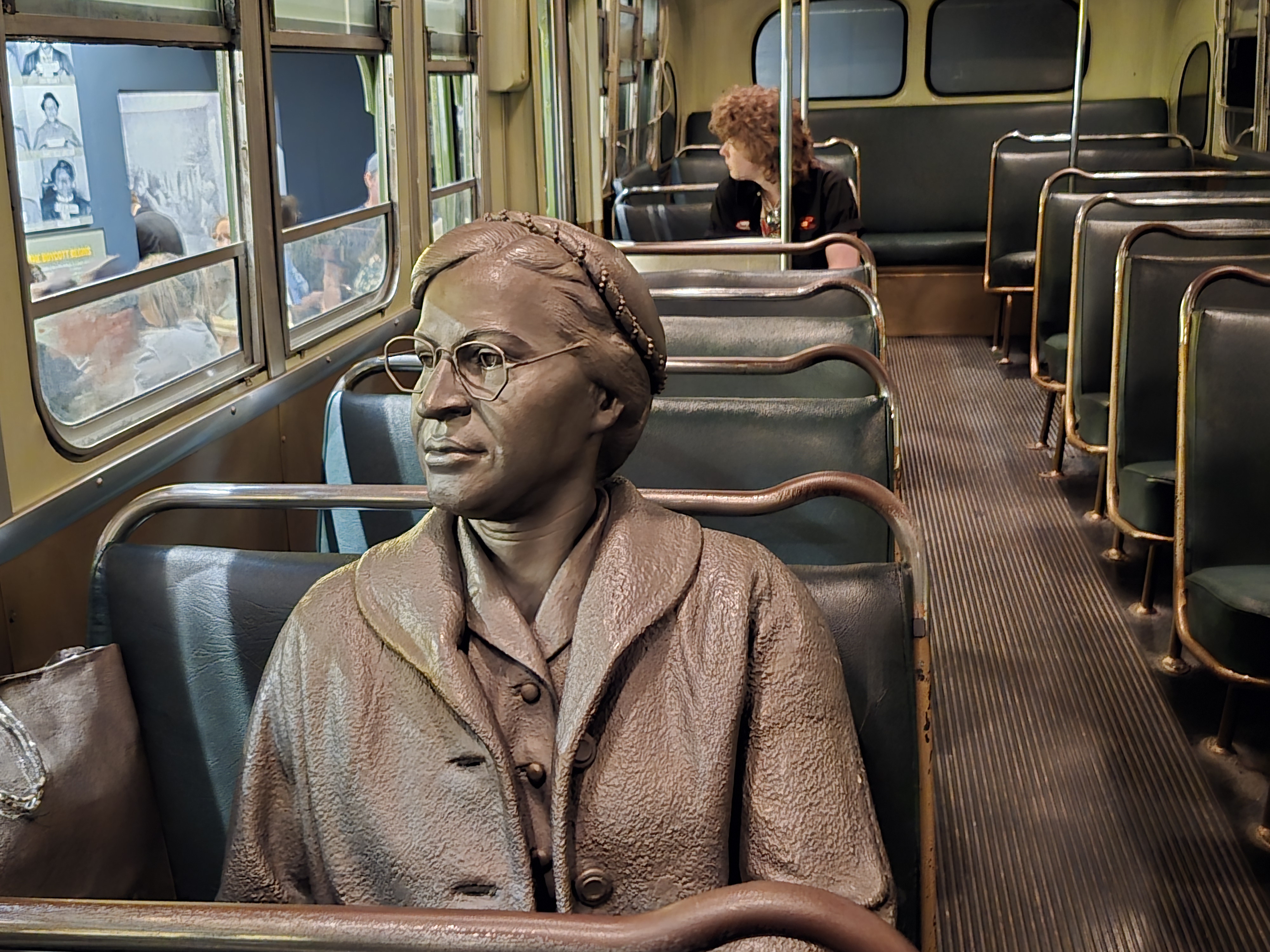
Rosa Parks famously refused to give up her seat to a white person on a Montgomery bus; she was arrested. In response to the racist act, thousands of Black residents became foot soldiers in the movement. For more than one year, they walked, they carpooled, they boycotted the bus system. They showed courage every day, and determination to make a difference.
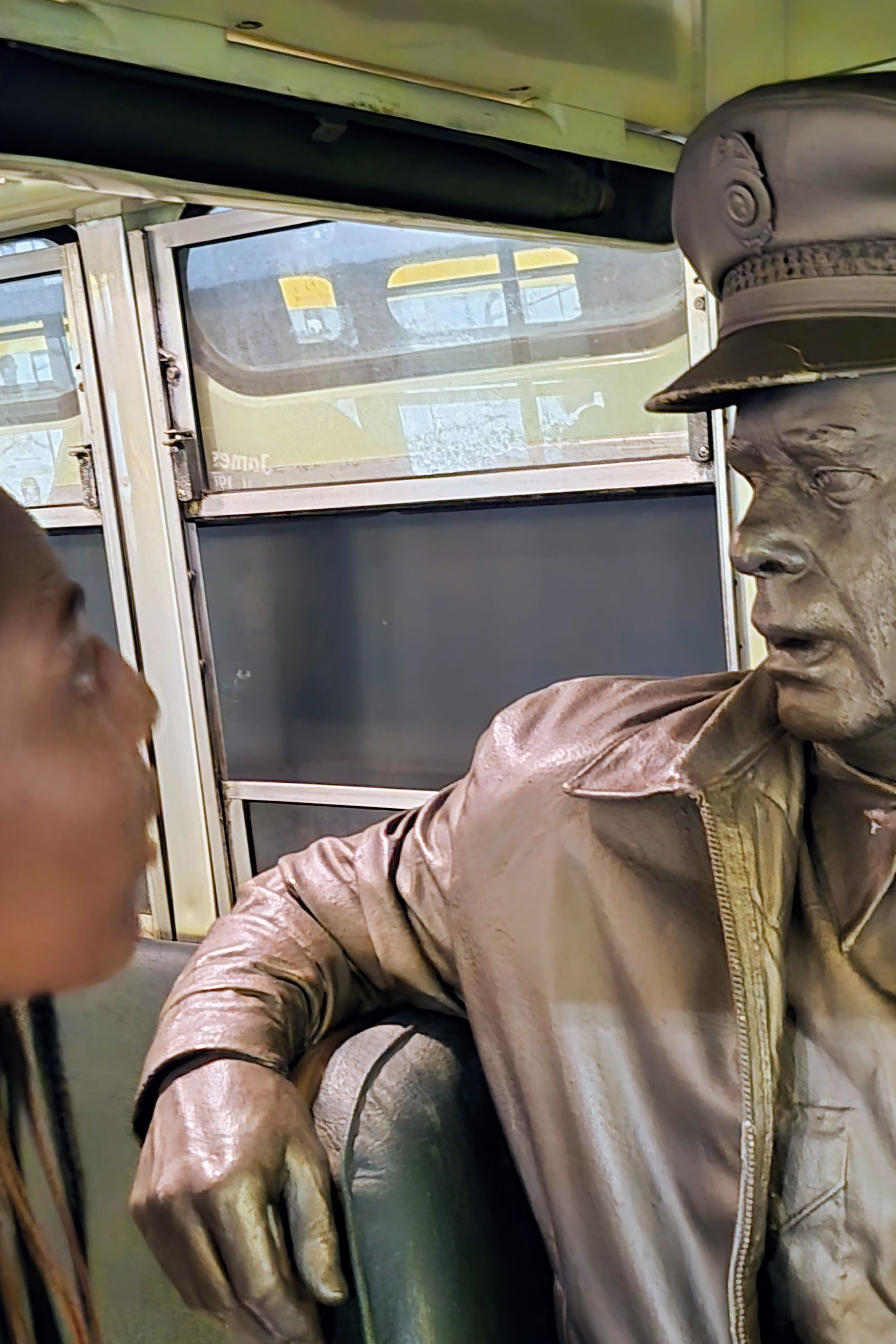
At the re-creation of that bus incident in Memphis’s National Civil Rights Museum, the bus driver’s statue attracted a mocking greeting from an African-American woman in March 2025: “Hey, Boy: What’s up?” The bus exhibit included recordings of the driver and Parks’ confrontation. Off the bus, I stood among the statues depicting weary people carrying groceries, walking steadfastly toward freedom: quiet heroes.
During this whole tour, March 22-28, 2025, the details sank into me. Yes, of course, Dr. King was assassinated at the Lorraine Motel, now enfolded by the Civil Rights Museum. That was horrific and moving. Of the 12 million estimated African people kidnapped and bound in chains for what would become the United States, one-third would die before completing the voyage across the Middle Passage. The tremendous wealth of white people in Mississippi before the Civil War was rooted in the huge numbers of enslaved people who had been transported in-country, south, to those productive cotton fields. Once they were “emancipated,” they outnumbered the whites—and white lynchings and Jim Crow codes were used to force them out or to murder them.
Among all these amazing people, a particular light shines in Fannie Lou Hamer. She had to leave the plantation where she worked because she was encouraging Black people to register to vote. She was sterilized without her knowledge or consent by a white doctor while being treated for a tumor. The control of bodies, tour leaders noted, is another way of keeping people from being free.
Ruleville, Mississippi, hosts the gravestones of Hamer and her husband in a park that remembers this passionate pleader for civil rights for African-Americans. She was not stopped by a beating that scarred her for life; she was not slowed by death threats on her phone; she built an agricultural haven for Black people before poor health took her life.
Hamer’s words are chiseled in stone in the park: “I guess if I’d had any sense, I’d have been scared but what was the point of being scared? The only thing they could do was kill me and it seemed they’d been trying to do that a little at a time since I could remember.” So Hamer lives.
From ordinary people to leaders like Hamer and Dr. Martin Luther King, Jr., those who fueled the movement for Black freedom would not turn back—and new leaders continue to arise, met with less fury yet continuing attempts at suppression.
During a visit to Memphis that happened to overlap with ours, Prof. Timothy Snyder, historian and author of “On Tryanny” and “On Freedom,” recorded a video on Civil Rights and Historical Honesty about the current administration’s executive order that would define as history that which lifts up their agenda—all else would be propaganda. Snyder resisted. “The truth, the truth about history,” he said, “and the truth about everything else is that it has to be there for us to discover. . . . If we want the people to rule, we have to understand one another.”
Even among the current spewing of executive orders at high levels, let us not catch the virus of blindly following leaders who would mislead us.
Although the 2025 March for Justice was a tough journey, emotionally, for me, I recognize that it was just one segment along a much more difficult, too often fatal, march toward freedom for so many of our fellow citizens.
What I saw: I saw that the soil activists blessed with their blood now nurtures red bud trees in blossom, wisteria vining wildly in abandoned places, and hope growing for the future we may create together.
Notes:
- We March for Justice is a week-long inter-generational study tour of the American Civil Rights Movement. The trip, which began under Cynthia Fraction 14 years ago, in 2025 included stops in Montgomery, Selma, Canton, Jackson, the Mississippi Delta, Oxford, and Memphis. Students studied the landscape of justice in America through field experiences, museum studies, readings, videos, encounters with foot soldiers of the movement, and class discussions. The tour explores a challenging history centered on racial oppression, the struggle for equality, and the endurance of Black lived experience. Explains Prof. Williard: “We talk about it as ‘intercontextual learning,’ where encounters among people (students, faculty, and foot soldiers), place, textual evidence, and interpretive spaces allow participants to think deeply across multiple levels of learning (from knowledge acquisition to critical evaluation to personal transformation).”
- Keeping it local to the Twin Cities: Sheletta Brundidge’s opinion piece in the Star Tribune, 1 April 2025. Sheletta: It’s not just police but people driving positive change in north Minneapolis
- In the decades since the Duluth Lynching, observers have noted that relatively few Black people live in Minnesota. “James Crow” or maybe it’s those formerly harsh winters, of which I have heard said: “They keep out the riff-raff.” Hmmm. Whose riff-raff?
 Allison Campbell Jensen
Allie,
Great job writing! Hard to read. Hard to believe. So heart-breaking. Tracy and I were talking this morning, wondering why God allows these kinds of horrors.
I recently heard from Trish about how much she treasured her time with you in Memphis. I love you and I am so proud of you.
Thank you for your courage. God bless you. May you embolden many more.
Love always, Gloria
>
Thank you for sharing this journey with me. Goosebumps. Steve